


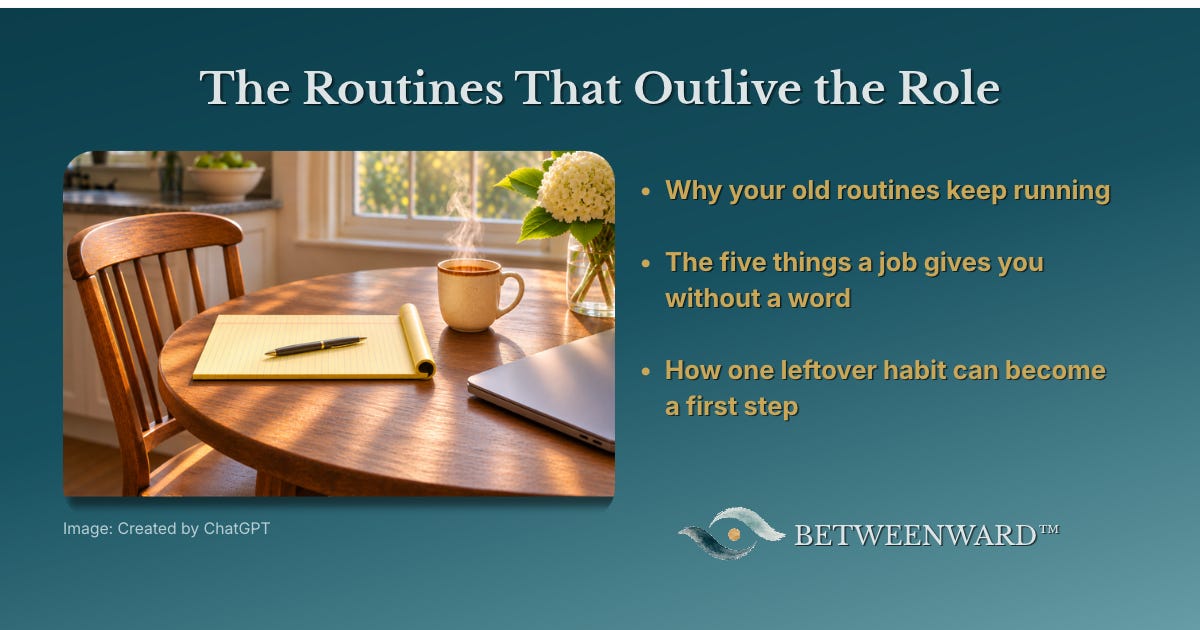
Ellen still sat down at the kitchen table every Sunday at seven. For twelve years, that hour had belonged to the week ahead. She’d open her calendar, look at which people on her team were stretched thin, and sketch out the conversations she needed to have before Monday’s staff meeting. By eight, she knew pretty well what the week would ask of her.
Then, her role ended when the company sold the division she ran. Six weeks later, she was still at the table at seven. That first Sunday, she opened her laptop out of habit and found a calendar holding a dentist appointment on Thursday and nothing else. She closed it and made tea, but the next Sunday she was back at the same hour, with the same pull to get ready for something.
She mentioned it to her sister on the phone, half laughing. “It’s like my body didn’t get the memo.”
Her sister asked what she missed about Sunday nights. Ellen started to answer and then stopped. What she missed was knowing what the week needed from her.
What the role was carrying
Ellen’s Sunday hour looks like a leftover, and in a way it is. It also points to something her job was doing for her that she never had to think about.
In the early 1980s, social psychologist Marie Jahoda argued that paid work gives people far more than income. Alongside the paycheck, she wrote, a job supplies five things most of us never think to list:¹
• A structure for time: a shape for the day and the week, from the first meeting to the last
• Social contact: regular conversation with people outside your own household
• Shared purpose: the sense of working with others toward something bigger than yourself
• Status and identity: a recognized place, and an easy answer when someone asks what you do
• Regular activity: a reason to get up and get moving
Decades later, psychologists Karsten Paul and Bernad Batinic tested her idea in a survey of 998 adults chosen to represent the German population, some in paid work and some not. People with jobs reported more of the first three and the last than people without jobs.
Status was the exception: people outside the paid workforce, such as students and homemakers, reported about as much as those with jobs, while people looking for work reported the least. Across the whole sample, having less of these things went along with more distress.² The survey captured a single point in time, so it can’t show what caused what. However, it does show how much of a working life rests on things nobody writes into a job description.
For capable people, those unwritten things often carry the most weight. The calendar told you where to be, and your team gave you people to think alongside. When the role ends, the routines built around them keep reaching for what used to be there.
The hour that was always mine
For as long as I can remember, my alarm has gone off at 5:45, and the first hour has been mine. I’ve always thought of it as play, pray, and plan. I play with my fur babies and pray for the day and the people I love. Then I plan, which for most of my corporate career meant opening my inbox and calendar to sort out who needed me first and what could wait.
When that role ended, the alarm kept going off at 5:45. I didn’t mind, and the play and the prayer carried on as they always had. Planning was another story. I’d open my inbox the way I always had, half expecting someone to be waiting on an answer, and find nothing that needed me. Through the rest of the morning I’d check again, as if something important might have slipped in while I wasn’t looking.
It took me a while to see what I was reaching for. Every morning, the inbox had told me where I was needed and in what order. Without it, I filled the hours with stuff to do so I could feel useful, and they kept me busy without telling me what mattered.
The mornings changed only after I hired a coach of my own. As I found a direction, new habits formed around it, and the planning part of that first hour carried more weight than it ever had. These days I plan around what I’ve chosen to work toward.
What the leftovers are telling you
Routines like these are easy to wave off as leftovers that will fade on their own.
Set beside Jahoda’s list, though, each one says something specific. Ellen’s Sunday hour reaches for structure, and for the shared purpose of getting a team ready for Monday. My inbox checks reached for something closer to identity: the steady confirmation that someone needed me.
A routine that keeps running after a role ends usually points to a part of that role you’ll want to rebuild somewhere new.
In The Ripple Journey™, the framework I created for moving through change, this belongs to the Inner Wave, the pause where you let what has ended land before you reach for what’s next. Leftover routines are among the clearest things to notice there, because they show you what you were leaning on.
They can also give you a place to begin. Organizational behavior professor Herminia Ibarra followed dozens of mid-career managers and professionals through major career changes. The ones who found their way tended to try small things first, learn from what happened, and let the direction take shape as they went. “Doing comes first,” she wrote, “knowing second.”³
A leftover routine is a natural home for one of those small things. You can keep the hour and change what it’s for.
A different Sunday
The Sunday after the call with her sister, Ellen sat down at seven as usual. This time she left the laptop closed and pulled out a legal pad. At the top she wrote one question: What do I want this week to ask of me?
Her first answer was small. She wanted one conversation with someone who would understand what she had built, so she wrote down the name of a former peer who had left the company a year earlier and sounded content ever since. She sent him a note on Monday morning.
By eight, the page held two names and one question she couldn’t answer yet. It felt more like her than the empty calendar had.
Ask yourself this: Which of your routines is still reaching for something your last role used to give you?
Know someone who’s still up at the old hour? Send this their way.
P.S. If you’d like company while you sort out what your routines are reaching for, join me for Between Currents™ on Wednesday, November 18th. It’s free, live, and the last session of 2026, and you’ll leave with a written record of the value you carry and one honest next step for the week ahead. Save your spot here.
Research cited
¹ Jahoda, M. (1981). Work, employment, and unemployment: Values, theories, and approaches in social research. American Psychologist, 36(2), 184–191. psycnet.apa.org/journals/amp/36/2/184. See also Jahoda, M. (1982). Employment and unemployment: A social-psychological analysis. Cambridge University Press.
² Paul, K. I., & Batinic, B. (2010). The need for work: Jahoda’s latent functions of employment in a representative sample of the German population. Journal of Organizational Behavior, 31(1), 45–64. https://doi.org/10.1002/job.622
³ Ibarra, H. (2002). How to stay stuck in the wrong career. Harvard Business Review, 80(12), 40–48. london.edu record. Expanded in Ibarra, H. (2003). Working identity: Unconventional strategies for reinventing your career. Harvard Business School Press.
María Tomás-Keegan is a career and leadership coach, award-winning author, and trusted guide for people moving through meaningful change in work and life. Through her coaching, writing, and speaking, she helps people reconnect with who they are now, trust the wisdom they’ve earned, and lead forward with clarity, courage, and alignment. She created The Ripple Journey™, a framework for transforming work and life, and co-founded Betweenward™ with Jerry W. Washington, Ed.D. Her articles’ client stories are composites of several people she’s worked with over the years, with details changed to protect their privacy.