


Two Drops, One Ripple
The ambulance came fast that evening. One phone call, and suddenly everything else in my life went on hold — the business, the calendar, and the version of the day I’d planned. People recognize that kind of disruption instantly. Say the words “he was rushed to the hospital,” and everyone understands: this is a crisis.
I think of moments like that as a Drop — the single event that lands in the middle of a life and sends ripples outward, changing the shape of everything around it. A diagnosis is a Drop. A phone call in the night is a Drop. And the Ripple is what comes after: the widening, unsettled water you’re left navigating once the surface has been disturbed, sometimes for weeks, sometimes for years.
That week in the hospital was a second Drop, though almost no one would have called it that. There was no siren or single moment to point to; just seven days of being present, useful, and invisible all at once. Because it didn’t look like a crisis, it didn’t get treated like one. And for a while, I didn’t treat it that way either.
Both Drops belong to the same Ripple: the ongoing work of loving someone whose body needs more than love can fix. The first kind gets casseroles, phone calls, and people asking if you’re holding up. The toll from the second kind accumulates imperceptibly, in a hospital room over a week, in a home over years. There’s no single moment anyone can point to; just the accumulation, and the silence around it.
So I started looking for anyone else who might know that silence.
The Car You Suddenly See Everywhere
I started googling, listening to podcasts on the drive home from the hospital, and reading interviews late at night when I couldn’t sleep. And then I noticed something else — the same thing that happens when you buy a car in a color you thought was unusual, and suddenly you see it everywhere. Once I started looking, I found caregivers everywhere. Some private, some public, some as unlikely as a late-night comedian.
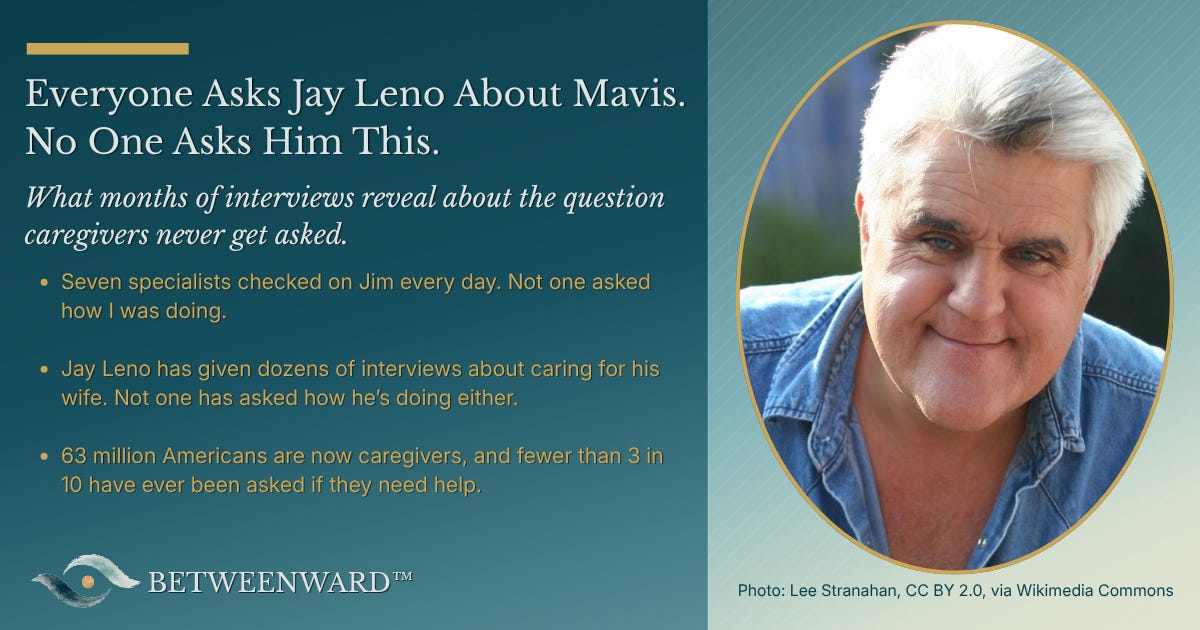
Jay Leno talked with Hoda Kotb on Today about caring for his wife, Mavis, through advanced dementia, and what struck me wasn’t the hardship; it was how he framed it. He described the toughest part of her decline: every morning, she relearns that her mother has died, and grieves it fresh, as if hearing it for the first time. He’s watched that happen for years. And in the same conversation, he reflected on what marriage vows actually mean once you’re called to live them out. Nobody expects to be tested on “for better or worse,” he said — but even the worse isn’t that bad.
I recognized that voice. It’s the same one in my own head most days — the one that finds meaning in the folding of towels, the shaving, the small tasks nobody assigns you but you do anyway because love looks like that now. Leno and I have never met, and our situations aren’t the same. But we’ve landed in the same emotional place: caregiving as honor, not burden.
Here’s what caught my attention, though, listening to that interview closely: every question was about Mavis. How is she doing? What’s she like now? What’s the hardest part of watching her decline? Not one question, in that interview, or in any other coverage I could find, asked how he was doing. He wasn’t asked about his health, his sleep, or what years of caregiving have cost him emotionally, physically, or mentally. One of the most visible caregivers in America, someone reporters clearly find compelling enough to keep asking about, still isn’t being asked the one question I was about to find waiting for me in a hospital room of my own.
What the Research Confirms
Once I recognized that pattern in his interviews, I wanted to know if it held beyond the two of us.
Family caregiving in America has exploded in the last decade. Caregiving in the US 2025, a joint report from AARP and the National Alliance for Caregiving, found that 63 million Americans — roughly 1 in 4 adults — are now providing ongoing care for an aging or seriously ill loved one, a 45% jump from just ten years earlier. One in five of us rate our own health as fair or poor. Nearly a quarter say they struggle to care for their own health while caring for someone else’s.
And the same report’s state-by-state companion, Caring Across States, found something I recognized immediately: healthcare systems routinely overlook caregivers, with few ever being asked about their own needs, despite their work being essential to how the system functions.
That gap isn’t new. An earlier Johns Hopkins Bloomberg School study, published in JAMA Network Open, found that while most caregivers said healthcare workers listened to them and asked whether they understood the patient’s treatment plan, fewer than 3 in 10 were ever asked whether they needed help managing the caregiving itself.
What’s changed since then isn’t the gap. It’s the number of us standing in it. Twenty million more caregivers have joined the ranks since 2015, and the questions being asked of us haven’t kept pace.
The system knows what it needs to know to treat the patient. It still doesn’t ask what it would need to know to protect the person standing next to the bed.
The Room Full of the Wrong Question
I saw exactly what that gap looks like from the inside, during Jim’s hospitalization.
For a week, Jim’s room had a rotating cast. The hospitalist came by each morning, then the cardiologist, and the pulmonologist. The attending nursing staff checked in every couple of hours with medications, blood draws, and vitals. The respiratory therapist came four times a day, and the physical therapist whenever his strength allowed. Each one asked him how he was doing, and asked me what I’d observed — his breathing, his appetite, his mood.
I was happy to answer every question.
In seven days of rotating shifts and digital check-ins, no one asked how I was doing. [Author’s Note: except Jim.] The cardiologist didn’t. The nurses and techs who saw me there daily didn’t. No one on staff, across every discipline the hospital had, thought to ask how I was managing the business I still had to run from the couch in his room, or the household that didn’t pause because Jim was in a bed on the fifth floor.
And every afternoon, I was the one helping him brush his teeth, wash up, shave, and comb his hair — because no one on the nursing staff ever did. I wasn’t doing it for efficiency. I was doing it so he could feel like himself for a few minutes a day, in a place designed to strip that away.
Nobody in that room considered me part of the patient. And in the ways that mattered to my own health, I wasn’t being treated as one either.
Why No One Asks
I’ve wondered, more than once, why this gap exists. I don’t think it’s because doctors and nurses don’t care. Every one of them who came through Jim’s room was kind, careful, and clearly good at their job.
I think it’s simpler and sadder than that: there’s no chart for me. No vitals to record, no treatment plan that needs my consent, and no box on the form. The system is built to track the person in the bed, and everyone standing beside it falls outside the frame. I don’t believe it’s from cruelty, but because nobody designed a place for us to be seen.
That doesn’t make it acceptable. It does make it fixable, if enough of us name it out loud.
So I’d like to ask you directly, whether you’re reading this on Substack, or you clicked over from Facebook or LinkedIn wondering if this was about you:
Have you felt invisible in a room full of people caring for someone you love?
And if so, why do you think the system is built this way? Is it really just an oversight, or is something else going on?
I’d love to hear your answers in the comments. This is exactly the kind of thing Betweenward exists to talk about because none of us should be figuring it out alone.
María Tomás-Keegan is a career and leadership coach, award-winning author, and trusted guide for people moving through meaningful change in work and life. Through her coaching, writing, and speaking, she helps people reconnect with who they are now, trust the wisdom they’ve earned, and lead forward with clarity, courage, and alignment. She created The Ripple Journey™, a framework for transforming work and life, and co-founded Betweenward™ with Jerry W. Washington, Ed.D.