



In 2016, while I was on terminal leave from the Marine Corps and still a Marine on paper, I dialed in for my first civilian job interview. The hiring manager picked up, put me on hold, and never came back.
I didn’t know what to do. So I stayed on the line.
I stayed there a long time. Nobody came back to tell me the call was over, and nothing in twenty-three years had trained me to make that call on my own. Eventually I hung up, dialed again, and we rescheduled.
That hold probably should have told me something about the job. I took the position anyway.
I have thought about that phone call for ten years. What replays in my mind is my side of the line. A combat engineer with five combat tours behind him, who had planned demolitions and run construction projects, sat with a phone to his ear, waiting for someone to tell him he could hang up.
I was good at moving
Marines move every three or four years. New post, new unit, new people, a new job to learn. I did it again and again. The longest I stayed anywhere was Okinawa, six years at the same duty station with my family beside me. It was a good stretch. Then new orders came, and we moved again.
Every one of those moves came with a structure. Orders told me where to go and the date to report. A sponsor at the new unit met me and showed me around. The longer I served, the more often that sponsor was someone I had already served with somewhere else. The relationship was there before I landed. The gaining command expected me. Everyone in the building could read my rank off my collar, and I already spoke the language before I walked in the door.
Retirement was the first move that came with none of that. No report date. No sponsor. No gaining unit. No one who could read what I had done by looking at me.
So when that manager put me on hold, I did what twenty-three years had trained me to do. I held my position until someone relieved me. Nobody did.
What the numbers say now
In 2020, as a doctoral student at USC Rossier, I wrote a short literature review on this transition. I read thirteen studies, book chapters, and interviews and concluded that the civilian world needed to meet each veteran as an individual, apart from the stereotype. The paper was never published. In September I pulled it back out and checked it against six years of new research.
The core held. The details got sharper.
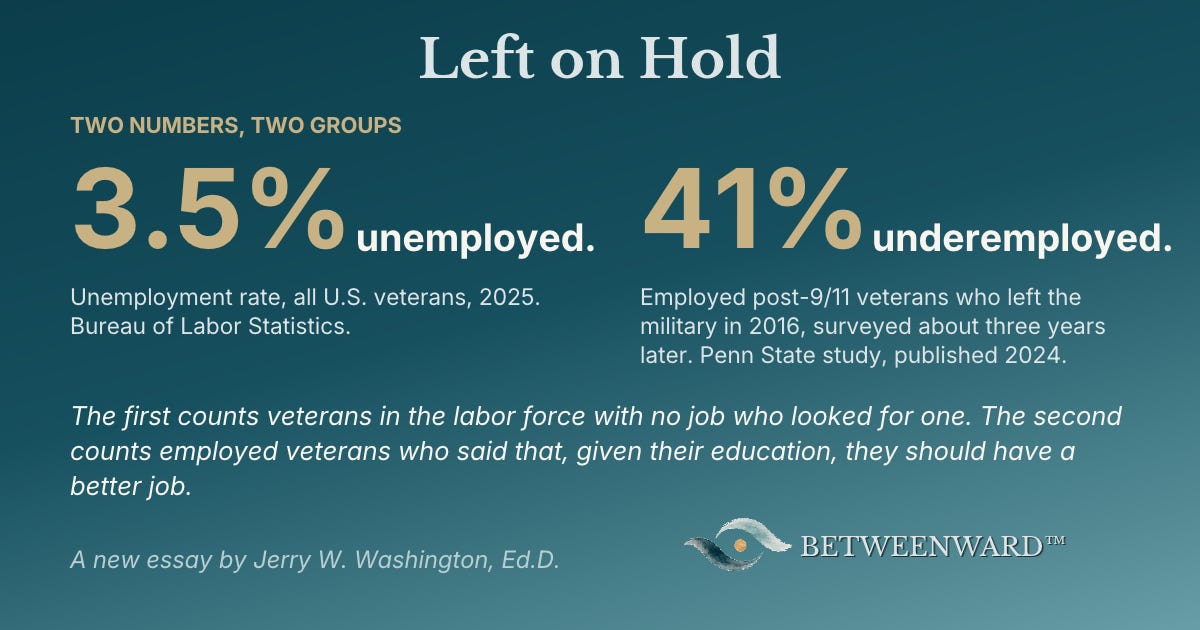
Veterans get hired. The Bureau of Labor Statistics reported in April 2026 that the veteran unemployment rate was 3.5 percent in 2025, below the 4.2 percent rate for people who never served on active duty. That number counts veterans who looked for work and had none.
The trouble starts after the offer letter. A Penn State team led by Katie Davenport followed about 3,000 post-9/11 veterans through their first years out of uniform. One in three reported underemployment: a job that did not match their education, experience or skills. Another 10 percent were underemployed and unhappy with their pay, and three years out of the military they earned $11,000 to $24,000 less than peers who reported neither problem. Veterans who were underemployed were nearly 90 percent more likely to leave their jobs. Those who were also unhappy with their pay were four times more likely.
I recognize that pattern. I left that first position for another company and stayed there almost nine years. Then I moved again, into the work I do now. Three civilian transitions in ten years, after a career made of them.
Years after I left, the preparation still started late. In 2019, Pew Research Center found that 48 percent of post-9/11 veterans said readjusting to civilian life was difficult, and 45 percent of all veterans said the military did not prepare them well for it. About 200,000 people leave the military each year. The Government Accountability Office reported in 2023 that, in data from April 2021 to March 2022, 70 percent of service members did not start the Transition Assistance Program a full year before separation, the timeline the rules generally require. The institution that wrote my orders for twenty-three years hands off the last move late.
What the other end of the line sees
In 2024, Michael Kirchner published a paper in the Journal of Veterans Studies that sorts the way the media portrays veterans into three portraits. The first is the asset: disciplined, a leader, a team player. The second is the liability: rigid, hypervigilant, possibly broken. The third is the social responsibility: someone who sacrificed and is owed care, portrayed with both pity and glory.
My 2020 paper only went after the second portrait. Kirchner’s point is harder. Each of the three, he argues, adds to the challenges veterans face in a career transition. The asset portrait can keep hiring managers from setting reasonable expectations. The liability portrait feeds hiring concerns that have not been clearly tied to a veteran’s ability to do the job. The social-responsibility portrait honors the sacrifice and overlooks the training and experience.
One finding from my original review still shocks me. In 2018, Christopher Stone, Mark Lengnick-Hall, and Jeffrey Muldoon reported in The Psychologist-Manager Journal that some hiring managers believed veterans had low social skills. The belief came from watching veterans stay quiet in meetings.
I know that quiet from the inside. In the Marine Corps I spoke up. I knew who owned the decision, what the room needed from me, and when my input was due. In civilian meetings I went quieter than I had ever been in uniform, and I stayed that way for a long time.
In those years I was a man still learning which rules the room ran on. A manager watching from across the table could easily have read my silence as having nothing to offer.
By my latest transition, I was speaking up a whole lot more. I would like to say that meant I had finally figured out civilian careers. I would be wrong to say that.
Who I was, who I am
The research I trust most on this transition treats it as identity work.
Fernando Fachin and Eduardo Davel studied forty-six years in the career of the Canadian filmmaker Denys Arcand, who made a contested shift from political documentaries to box-office success. Their 2015 study asks how a person finds a new path while holding three questions at once: who I am, who I was, and whom I want to become.
Every reader of this publication carries some version of those three questions. A title ends. A career closes. A caregiving season starts. The résumé stops describing the person holding it.
The Swedish researcher Jan Grimell interviewed nineteen Swedish service members once a year from 2013 to 2016 as they left the military. In his 2017 study, the self is a set of voices: the soldier, the civilian, and an existential voice asking what any of it meant. The Marine and the civilian could share the same room.
Veterans carry one extra load in that work. Other people arrive with a picture of us already drawn. Part of the job is refusing to confuse their picture with who we are.
The person who moved with me
When I went to Okinawa, my family went too. Every set of orders I received, they received. Those orders moved a whole household, and each one asked a spouse to set aside a career, a set of plans and a sense of stability. My 2020 paper named military spouses and then gave them a single paragraph. They deserve more than that.
For a military spouse, putting down roots never came easy. Every move meant starting over: a new community, new schools, new friends and, for many, one more attempt at a career. Landing a job was one hurdle. Finding an employer willing to invest in long-term growth was a second, harder one.
Picture wanting to build a career, earn your leadership’s trust and work your way up, while knowing the next set of orders could end it. The ambition, the commitment and the ability all stay intact. Circumstances outside the spouse’s control set the limits. And the stigma veterans meet when they leave the service often reaches the spouse years earlier, while the service member is still in uniform.
Angie Maldonado read an early draft of this essay and sent back three lenses employers use for military spouses. They sit right beside Kirchner’s portraits of veterans.
The first is the liability: a spouse who may leave when the next orders arrive, whose schedule may be unpredictable, an investment the organization would rather not make. The second is the social responsibility: a family sacrificing for the country, owed our support. Angie’s question for that employer is the sharpest line I received on this draft: “We are willing to give them a job, but are we willing to give them a career?” The third is the symbolic hire: a spouse whose employment lets an organization show its support for military families. That commitment has value. Her test is whether it reaches past the hiring decision into development, recognition and the same path to promotion anyone else gets.
All three lenses define a spouse by circumstance and leave capability out of the picture.
The Military Family Advisory Network’s 2025 survey, released in June, found that 29.9 percent of active-duty spouses looking for work were unemployed, up from 21.8 percent in 2023. Counting methods differ: the Defense Department’s own formula lands near 20 percent, and federal standards would bring it to about 14 percent, still well above the national average. Roughly 36 percent of spouses are not in the workforce at all. A three-year study by Blue Star Families and Syracuse University’s Institute for Veterans and Military Families found that only 22 percent of the participating spouses held full-time work the entire time, even though 43 percent held advanced degrees.
Read those numbers as a count of education, experience and talent that employers keep passing over. Every move asks a spouse to rebuild a home, a community, a career and sometimes professional confidence. We tend to describe those sacrifices as support for the service member and say little about what the spouse gave up.
Military spouses show their commitment every time they rebuild. Employers have been slow to count that same commitment as a strength at work. In December 2025, Congress created a transition pilot program for military spouses in the annual defense bill, more than three decades after it created the Transition Assistance Program for service members.
The spouse has been making the move the whole time.
Write your own orders
Cut your own orders for the next move.
Pick a report date. Name the day you start the next thing, even if the thing is still taking shape. A date turns a drift into a move.
Find a sponsor. Look for someone who made a crossing like yours two or three years ahead of you, and ask them to walk you around. Buy the coffee. Ask what they wish someone had told them in the first month.
Learn the language of the gaining unit before you get there. Every workplace, every volunteer board, every new field has words that mean something specific inside the building. Learn them early and your first months get shorter.
And decide in advance how long you will hold. I sat on that phone line far longer than I should have, waiting for permission I did not need. Set your limit before the call starts. When you reach it, hang up and dial again.
If you hire people coming out of the military, one request. When your new hire goes quiet in a meeting, ask them what they see. You will likely get the most useful sentence of the hour.
If you hire a military spouse, talk about the career path on the first day, the way you would with anyone else. Then ask what it would take to keep the work going when the next orders come.
So here is my question for you. If you wrote your own orders tonight, what report date would you put on them, and whose name would go in the sponsor block? Tell me in the comments. I read every one.
This essay began as a paper I wrote at USC Rossier in 2020. My friend Abdiel Maldonado and I later worked to revise it for publication. We never finished; Abdiel passed away before we could. This version is the one we meant to write, and it is for him. Angie Maldonado read the draft and reshaped its section on military spouses.
Jerry W. Washington, Ed.D., is a Marine Corps veteran of twenty-three years and co-founder of Betweenward, a space for people building what comes next when the old method has stopped working. He also publishes What Time Binds on Substack, where he writes on institutional accountability and public memory. He holds a doctorate in Organizational Change and Leadership from USC Rossier, teaches at UC Irvine’s Division of Continuing Education, and is the author of Adulthood of Humanity (2026).