


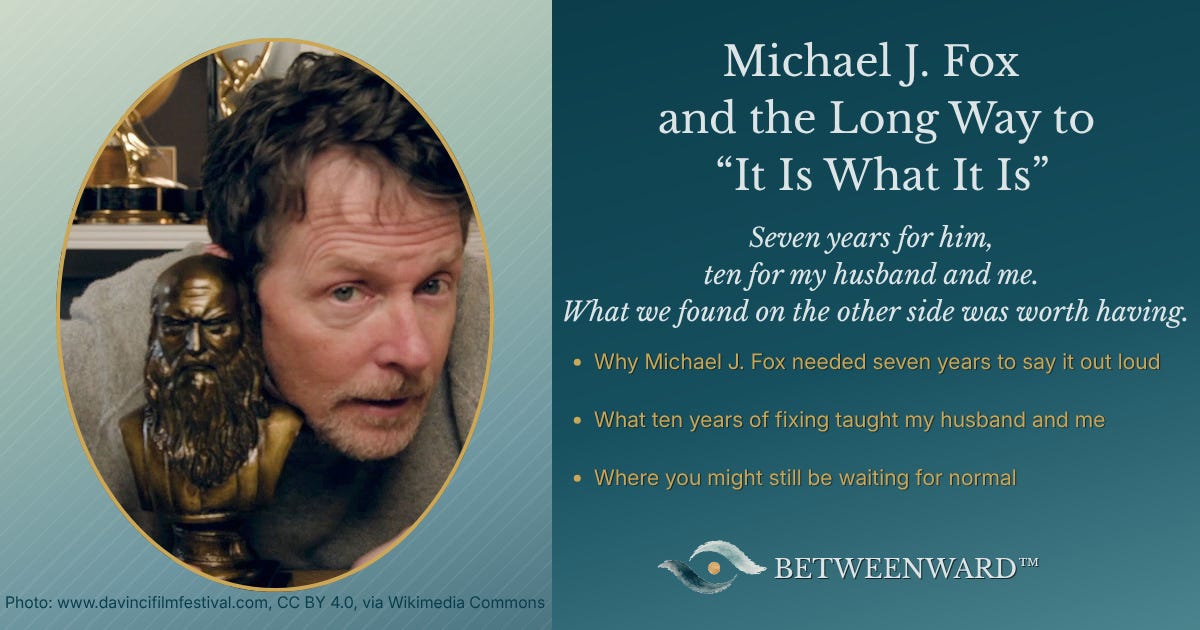
In November 2022, Michael J. Fox accepted the Academy of Motion Picture Arts and Sciences' Jean Hersholt Humanitarian Award. By then, he had lived with Parkinson’s disease for more than thirty years, and many in the room knew him for his foundation as well as his films. He used part of his speech to go back to the beginning.
He was 29 when the diagnosis came. “Then I entered into seven years of denial, trying to make sense of it all,” he told the audience. “I told very few people. And they kept my secret.”1 Through those years, he kept working, and he has since talked about turning to alcohol to cope.2 He went public in 1998, while starring in Spin City.
One line from that night stays with me: “I only knew that it would get worse.” The diagnosis was certain. Letting it in took him seven years.
The script we reach for first
Sociologist Arthur Frank spent years listening to how people tell the stories of their illnesses. In The Wounded Storyteller, he describes the story most of us reach for first, which he calls the restitution narrative: “Yesterday I was healthy, today I’m sick, but tomorrow I’ll be healthy again.” Frank calls it the story our culture prefers.3
It’s also the story capable people have lived by in every other part of their lives. A plan breaks, and you fix it. A job ends, and you find a better one. Competence is mostly the skill of putting things back the way they were, and it works so often that we stop noticing it’s a script at all.
Seen this way, Fox’s seven years were the script still running. When everything you know says hard things get fixed, accepting one that won’t takes time.
I know that script from the inside.
Ten years of fixing
Jim has played sports since he was five. When his back started giving him trouble, he was still playing competitive baseball and softball, and he could run like a deer. Walking was what hurt.
So we did what capable people do. We found a spine specialist, then a new approach each time the last one fell short. Over ten years, that meant four back surgeries and a spinal cord stimulator, with injections for temporary relief in between.
I was the researcher. Every time something didn’t work, I went looking for the next thing that might, booked the scans, and rearranged our calendar around the next appointment.
After the fourth surgery, a specialist told us he wouldn’t recommend another. The odds it would make Jim worse were 50/50, and he said pain management was the best long-term plan.
The ride home was silent, each of us working through it alone. That evening we cried together, and Jim said, “I can’t handle worse.” So we turned the energy we’d spent chasing a fix toward everything pain management could offer.
Even then, the letting go came in pieces. Baseball and softball went first. Jim tried his best to hold on to golf and bowling, until golf became too much walking and twisting. Bowling lasted longest, until the night he came home from the alley and said, “I think I need to be done.” I agreed, and it hurt us both to say it.
We spent ten years trying to fix something we couldn’t fix. Degenerating discs only go one direction. What we could change was how Jim lived with the pain. “It is what it is” became our mantra, and now we plan everything, even the smallest outing, around his medication schedule so he’s as comfortable as possible.
When the script breaks
Frank describes two other stories people tell once restitution stops working. One he calls chaos: a life that “cannot be imagined improving,” told by someone too deep inside it to step back. Chaos stories are hard to listen to, so they often go unheard. The other he calls the quest, where people accept the illness and look for a way to make it useful.3
People rarely move between these stories in a straight line. Chaos often comes first, and a quest tends to grow out of it once someone is willing to listen. Fox’s life after 1998 is one of the best-known quests there is. Within two years of going public, he had started a foundation for Parkinson’s research, and he has written about living with the disease in several memoirs.
Where the script hides
Most readers won’t face a diagnosis like Fox’s or Jim’s. The script runs anyway, in milder forms that are easier to miss. You may see it in a job search aimed squarely at the role you just lost, or in a marriage you keep working on until it feels the way it used to. Sometimes it’s a body you keep training back toward how it moved before.
Each of those efforts can be the right one. What’s worth noticing is the assumption that rides along with it: that the goal is to get back to what was. As long as that’s the goal, the time in between feels like failure, and every month that normal doesn’t return counts against you.
In The Ripple Journey™, the Inner Wave is where the script is allowed to break. It’s the pause where you let what happened land before reaching for what’s next. For Jim and me, that pause began on a silent ride home and took years to finish.
Living inside what changed
In 2020, Fox stepped away from acting. Parkinson’s had made it hard to remember lines and work on set, and he later called the decision “non-emotional and kind of ok.” In 2026, he returned for a role in the third season of Shrinking, playing a character with Parkinson’s. He asked for the part himself. It’s “not the beginning of any campaign to reestablish my career,” he said. “Just do that for its own sake. I don’t have an agenda.”4
That’s what The Ripple Journey™ calls Still Water: living more honestly and fully inside what has changed, rather than returning to what was.
Our version is smaller and closer to home. For years, our shared social life ran through Jim’s games and the friends who came with them. When he stopped playing, we found that each other’s company filled what the games had left open. It’s amazing what we talk about when we’re not rehashing the results of a ball game. Our friends come to us now, and I get to entertain again, something I hadn’t done in years because we were always heading out to watch or play.
Ask yourself this: Where are you still waiting to get back to normal, and what might open up if you stopped waiting?
Sources
¹ Cohen, L. (2022, November 21). Michael J. Fox says he was in “7 years of denial” after Parkinson’s diagnosis. CBS News. https://www.cbsnews.com/news/michael-j-fox-parkinsons-diagnosis-7-years-of-denial-i-only-knew-that-it-would-get-worse/
² Guggenheim, D. (Director). (2023). Still: A Michael J. Fox Movie [Documentary]. Apple TV+.
³ Frank, A. W. (1995). The wounded storyteller: Body, illness, and ethics. University of Chicago Press. (Restitution, p. 77; chaos, p. 97; quest, p. 115.)
⁴ Michael J. Fox gives retirement update amid return to acting: “I don’t have an agenda.” (2026, January 29). Parade, reporting Fox’s interview with the Los Angeles Times. https://parade.com/news/michael-j-fox-gives-retirement-update-amid-return-to-acting-i-dont-have-an-agenda
María Tomás-Keegan is a career and leadership coach, award-winning author, and trusted guide for people moving through meaningful change in work and life. Through her coaching, writing, and speaking, she helps people reconnect with who they are now, trust the wisdom they’ve earned, and lead forward with clarity, courage, and alignment. She created The Ripple Journey™, a framework for transforming work and life, and co-founded Betweenward™ with Jerry W. Washington, Ed.D. Her articles’ client stories are composites of several people she’s worked with over the years, with details changed to protect their privacy.