


Guest article by Tony Washington
Physicist Richard Feynman once described a stretch in his career when physics had stopped being fun for him. So he gave himself permission to stop worrying about whether the problems he worked on were important and just mess around with whatever caught his attention.
One day in the university cafeteria, somebody tossed a plate into the air. Feynman noticed the way it wobbled and started working out the physics behind the motion. He had no grand research question in mind or some larger purpose he was trying to serve. He was just curious about a wobbling plate, and so he followed that curiosity.
His little detour eventually connected back to work that helped earn him a Nobel Prize. But that’s not my point in telling his story. Long before that detour amounted to anything, Feynman had given himself time with no particular destination in mind.
I’m no physicist, and I see no Nobel Prize in my immediate future. But this summer, I unexpectedly found myself with a stretch of time that looked just as destination-less and as primed for curiosity.
In April, I resigned from a company where I had worked for 15 years to focus on a graduate program I had started in January. By May, the consequences of those life-changing decisions caught up with me, physically. I developed a persistent cough that progressed to a bad case of bronchitis, as if there’s ever a good case.
I finished my first semester in the program emotionally and physically drained, not how I wanted to start my graduate career. On the advice of a trusted friend, I opted out of summer courses to recuperate, even though doing so risked keeping me from my goal of finishing the program in under two years.
So, there I was at the start of June, destination-free. I had no priorities to fixate on except taking care of myself. No work and no school meant no predictable schedule to follow or demands to meet for the next three months.
Everyone’s dream scenario, right? How easily we tie productivity to our sense of worth can leave a mark you don’t notice until later.
I initially felt scattered, unmoored by the freedom I stumbled upon. You know that disorienting sensation you get when you wake up in a new place for the first time? That was my mornings the first few weeks.
I tried focusing on taking meaningful actions to provide some semblance of structure. I finished planning an ambitious fiction project I intended to start in the fall. I participated in a four-week seminar on “reimagining work,” a timely topic. I brainstormed on what I might do with the degree after I finished.
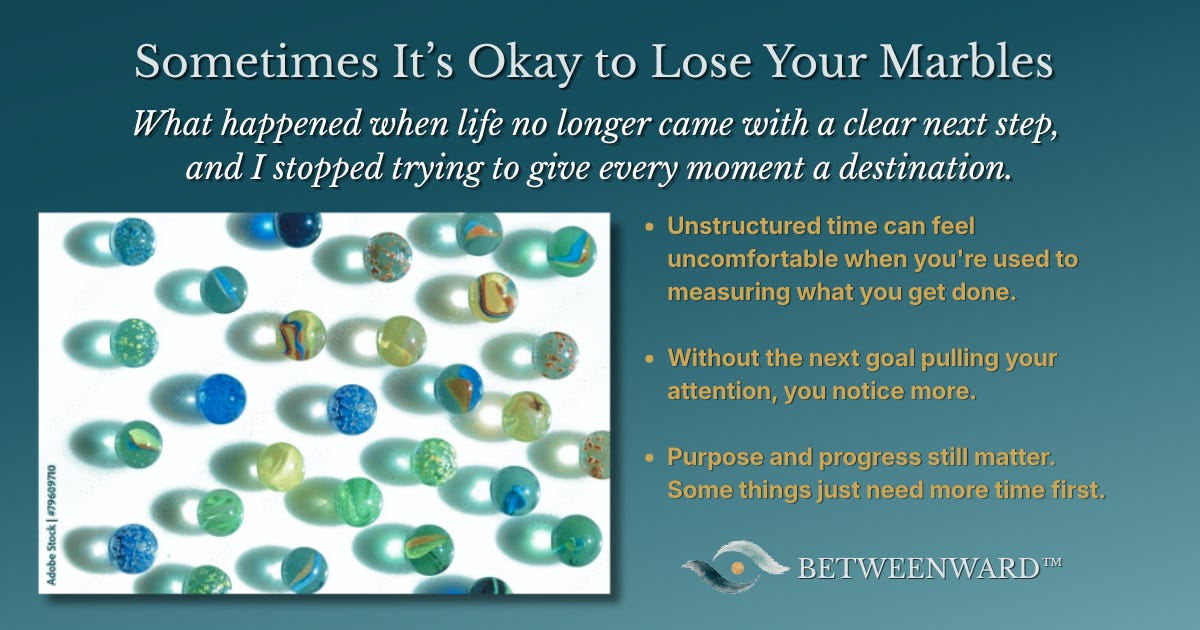
But those old high-achieving tools of the trade no longer worked. They were designed for tasks that didn’t fit where I was. And I was definitely somewhere else. Collecting my thoughts, as I normally would, felt like grasping at wet marbles on an already slippery floor.
Exasperated, I decided to do something I hadn’t had the chance to do in a very long time. I sat still and just let my mind wander, something scholars describe as spontaneous thought that moves with relatively few constraints.
I stopped chasing after the marbles and just let them roll, leaning into my curiosity to see where they might go. That included not judging their direction or distance, or even the velocity at which they traveled.
Sitting still knotted my stomach, of course. I had spent years developing a professional ethos of defining a clear purpose, choosing priorities that align with that purpose, and measuring outcomes against a clear idea of what progress looks like.
Underlying that ethos was a sense of movement toward some end. So, sitting still felt like I was forsaking the very core of who I was. Someone ever marching toward growth.
But an important question emerged in my discomfort: What happens when someone like me, accustomed to giving purpose and direction to just about every activity, suddenly has the freedom to let things just unfold?
I knew I was in a fortunate position to be able to take a detour off my path and explore. Opportunities like that don’t come along very often. So I decided to seize my moment.
In my limited reading on what I was about to embark on, I came across the recurring idea that wandering needs room to happen. That usually means unstructured time and fewer constraints on where your attention goes. I had both in abundance, though reveling in them took some practice.
Sometimes I set my alarm later than normal or not at all. Sometimes I woke up unprompted to go for a walk in the first morning light. I spent more time with my parrot Jewel, teaching her how to play with her toys and sitting with her on the front steps to watch the squirrels scurry about.
I met friends for coffee or lunch, and in the process met new people doing interesting things. I created new song lists to listen to while I write. I read without purpose, sometimes stopping midway through to look up references that piqued my curiosity.
Accepting that unstructured pace took some time. I didn’t realize how out of practice I was. Modern life tends to focus our attention on one muscle group (achieving life goals) while letting others atrophy (experiencing life itself).
But the more flexible rhythm of living helped me to flex my old muscles of noticing. Many of those marbles kept rolling about, and that was okay. A few landed at points of greater (though not full) clarity. Not a “wobbly plate” kind of epiphany, but enough insights to help me name what I was seeking, where I felt lacking, where I might grow, and how I might live more closely to my values.
One marble landed on work. The seminar on reimagining work helped me see how we narrow that concept to one arrangement (a job) and then cram it with so many functions (income, identity, community, status). Stepping outside that arrangement opened opportunities to imagine different ones.
Another landed on pace. I’ve never had a problem accepting the need for “good enough” when the moment calls for it. But other moments deserve the time it takes to get to a “damn, that’s good.” We could use a few more of those.
For me, creating space for those moments might mean choosing which of my two big passions gets most of my attention first. Trying to push both forward at the same time risks doing neither one well. I don’t have that sorted out yet, but at least I can name the decision more clearly now.
Life is filling back up again. I have classes, projects, and decisions to make. As I get back into the groove, my old professional ethos still makes sense. I see no reason to throw out purpose, priority, and progress.
But I might just have to leave a little more room before I start assigning purpose and measuring progress. Give some things enough time to unfold before I decide what they are or where they should go.
Looking back, maybe I shouldn't say I lost my marbles over the summer. It felt like that at the time, understandably. Maybe I just stopped insisting that they all stay where I put them.
Tony Washington is a writer and systems thinker interested in how people make sense of complex situations. His work explores the interplay of cognition, technology, culture, and the environments that affect what people are able to see.