


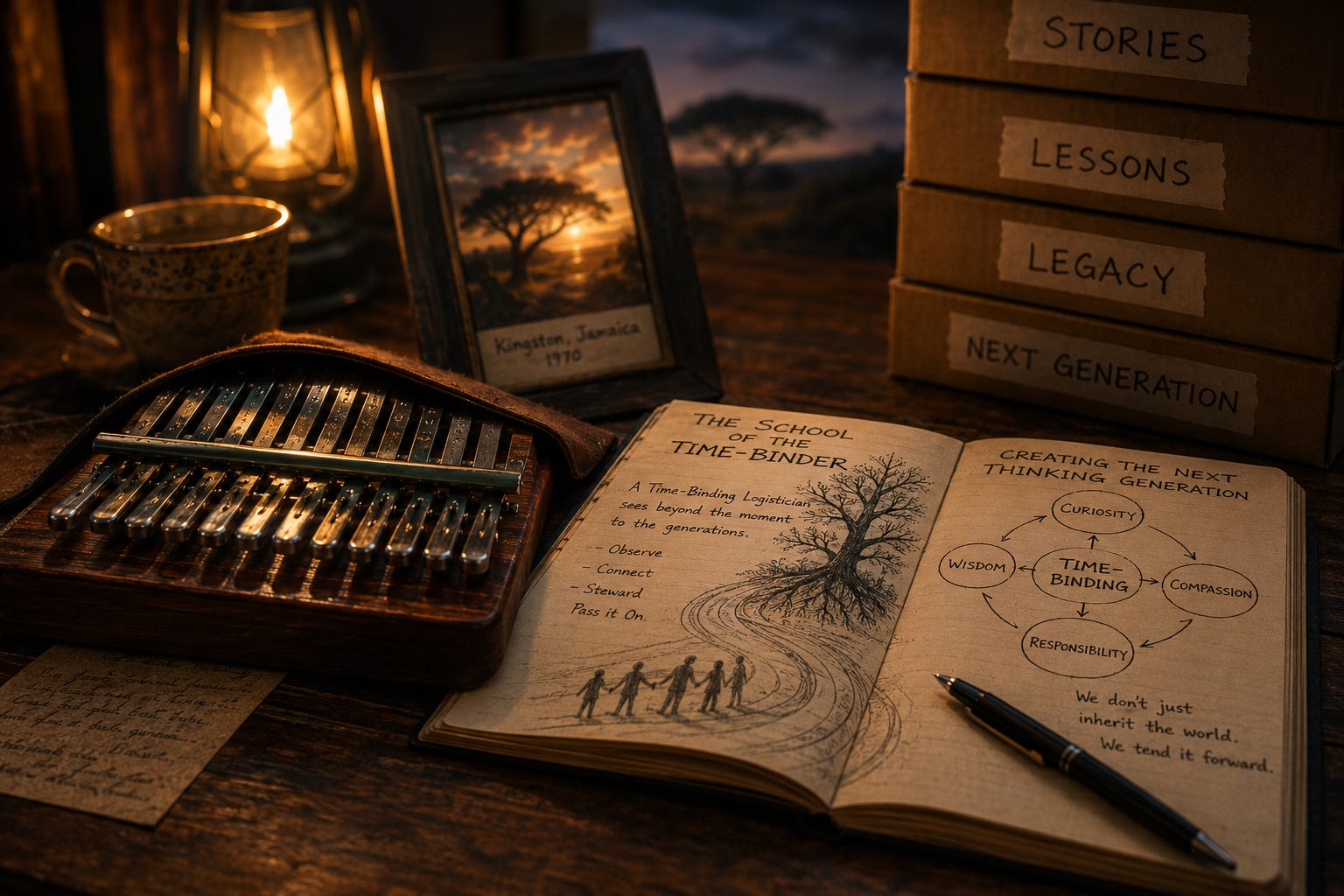
David was twenty-four, sitting on the floor of the Kingston airport, playing his thumb piano. He had just been expelled from a church work camp in Haiti, with the rest of the summer suddenly open in front of him. So, he did what he always does. He played.
A man stopped to listen and asked about the instrument. The two of them talked, and it turned out the man ran Jamaica’s board of tourism. He had a large house in Kingston, and he offered David a room there, free of charge, for the rest of the summer. David spent the next several weeks traveling the length of the island as his guest.
That is where his curiosity took him. To understand how he got there, you have to go back a few months, to an orientation room in Port-au-Prince.
The three kinds
When I asked David how he keeps his curiosity alive at 80, he didn’t reach for a memory. He looked it up. He typed the word into his phone, read me the definition out loud, and started sorting himself into the categories.
There are three kinds, he told me. Diversive curiosity, the pull toward anything new. Epistemic curiosity, the drive to know one subject all the way down. And empathetic curiosity, the wish to understand what another person is feeling and thinking. He claimed all three. He owned the first one with a confession: he has been called snoopy, and once asked a woman at a dinner so many questions that she told him she felt interviewed, so he backed off.
The one that stuck out is the third. For David, empathetic curiosity is how he gets close to people, and getting close to people is how he gets close to himself. “By dancing with other people,” he said, “it helps me get in touch with the dance inside of me.”
My own curiosity runs on a different question. Where David reaches for what a person is feeling, I reach for how a thing works, the mechanism under the surface. Same engine, different target.
Careful and diligent
He found something in the etymology that stopped him. The word curiosity comes from the Latin for careful, or diligent. He asked me why care would sit at the root of curiosity. The link is attention. A curious person looks at what most people walk past. We all run on shortcuts, the mental rules that get us through a day without examining everything. Curiosity is the diligence to set the shortcut down and look again, to ask the question the room has agreed not to ask.
The animal test
David is precise about why he guards this. He told me, with no apology, about a visit to his doctor. Everything checked out, and then the doctor said he wanted to run one more test, given David’s age. A test for dementia.
David did not care for the word. He decided, on the spot, that whatever else went in his file, that word would stay out of it. The test was simple: name as many animals as you can in one minute. Go. Zebra, horse, dog, cat, moose, giraffe, lion, rat, on and on. The threshold was sixteen. He got eighteen, barely clearing it. The next year he practiced and got twenty.
Then he delivered the punchline he had been setting up the whole time. The real reason he stays curious, he said, is so nobody finds out he’s demented. He let it land, the way the two women who each lived to 103 told him never to lose the joke. The joke carried the truth underneath it: he keeps his curiosity in shape the way other people keep a muscle in shape, refusing to let it go slack.
Port-au-Prince, 1970
Which brings us back to Haiti.
In 1970, David joined a volunteer work camp building a public health dispensary in the hills above Port-au-Prince. Two groups sponsored it: the Church of Christ and the American Friends Service Committee, the Quaker organization. He had spent three years in Africa studying the instruments connected to religious ceremonies, and he had come to Haiti to do the same with the music of voodoo.
At orientation, they told him the rule. While he was on the island, he would not be permitted to attend voodoo ceremonies. David raised his hand. He said that studying those ceremonies was the entire reason he had come, and that the ban looked to him like religious discrimination. They held the line. Attend a ceremony, they told him, and you are out of the program.
He understood the choice in front of him. He had watched conservative missionary groups across Haiti work to replace what people remembered of their own music, art, and religion. He did the pick-and-shovel labor on the dispensary for a few months. And he went to the ceremonies anyway. They expelled him.
The door in Kingston
The trait that got him thrown out of the program is the trait that got him the summer. He would not stop following the thing he was curious about. Following it cost him his place in the camp. Following it also walked him into the Kingston airport with a thumb piano and out of it with a host, a house, and an island to explore.
This is the pattern worth naming for anyone building a next chapter after 50. Curiosity works like a practice. It can be built, kept in shape, and allowed to go slack. Like any practice, it asks something of you. Sometimes it asks you to be the one person in the room who says the rule is wrong. Sometimes it costs you the safe spot. David has been paying that price and collecting that return for sixty years, and at 80 he is still doing it, phone in hand, sorting himself into categories, naming animals so the word never lands on his chart.
The thumb piano has opened a lot of doors in this series. The one in Kingston may be the clearest. He had lost the program. He sat down and played. The next door opened.
Where we go next
One story has been waiting since the beginning: the woman David met in Tanzania in 1965, a nurse who studied in Ireland and came home speaking Swahili with an Irish accent. We meet again soon. I think it’s time.
David Thiermann, 80, lives in Santa Cruz, California. He holds a thumb piano, a long memory, and, by his doctor’s count, at least twenty animals’ worth of curiosity. He is, by his own account, an improviser.
Jerry W. Washington, Ed.D., is a Marine Corps veteran of twenty-three years and co-founder of Betweenward, a space for people building what comes next when the old method has stopped working. He also publishes What Time Binds on Substack, where he writes on institutional accountability and public memory. He holds a doctorate in Organizational Change and Leadership from USC Rossier, teaches at UC Irvine’s Division of Continuing Education, and is the author of Adulthood of Humanity (2026).