


A career ends before you’re ready to be done with it. A body stops moving the way it used to. Caring for someone else starts shaping every hour of your day. A world seems to change its rules faster than anyone can teach them to you — a marriage, a diagnosis, a home that empties.
Different rooms, the same floor plan underneath. We move through plenty of transitions in a lifetime, some fast, some slow, but the pattern underneath tends to repeat, and so does the way it feels while you’re standing in it.
Moving forward feels uncertain, and going backward isn’t something you’d even consider. So where does that leave you? We call it Betweenward. You’re standing in a room between what was and what’s next, and that room turns out to be real, with its own shape and its own timeline. It deserves your attention, whether anyone ever taught you to recognize it or not. Most people don’t; they rush right through it instead.
That’s a mistake because researchers have studied this space more than once, and what they’ve found changes how we should treat the in-between.
The middle isn’t one thing
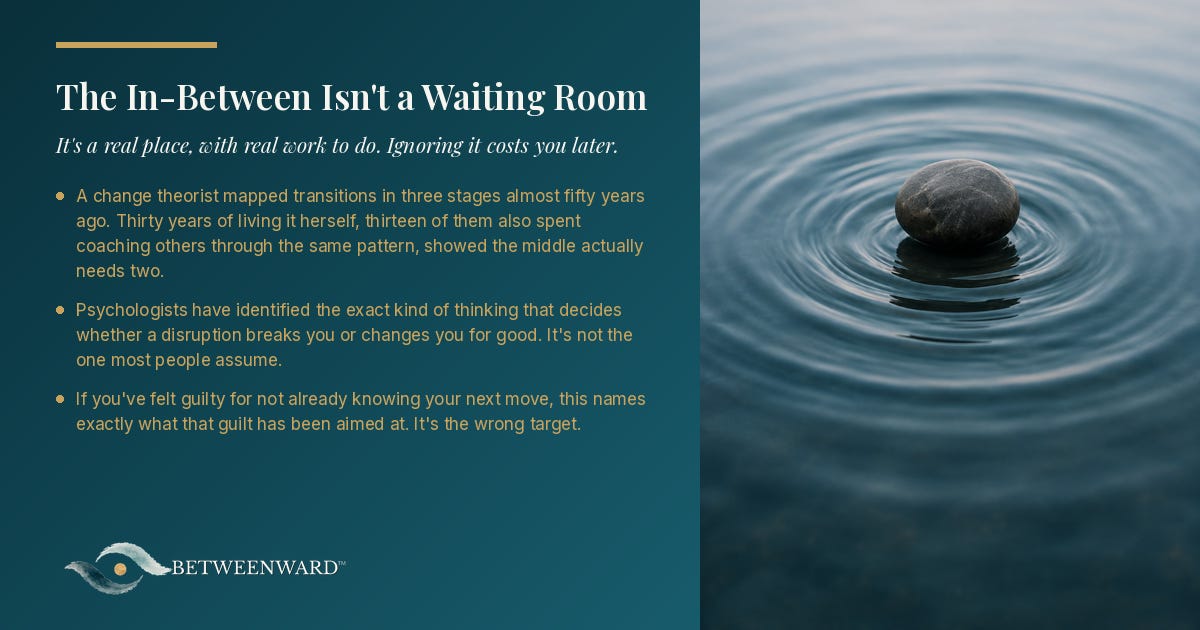
Nearly fifty years ago, a former literature professor named William Bridges started writing about change, and noticed something that held up across every transition he studied: the outside event and the internal process are two different things, and the internal process moves through three stages: an ending, a middle he called the neutral zone, and a new beginning.
Bridges wasn’t the first to notice the middle has its own shape. Decades earlier, a French anthropologist named Arnold van Gennep studied rites of passage across cultures and found the same three-part structure everywhere: separation from an old status, a liminal middle belonging to neither the past nor the future, and eventual incorporation into something new. Cultures that built rituals around this didn’t treat the liminal stage as wasted time. They built ceremony around it because they understood it did the work that nothing else could.
Both maps agree on the shape: an ending, a middle, a resolution. The Ripple Journey doesn’t reject either one. It expands the middle they both compressed into a single stage, and it tells a different story about what the resolution itself looks like. That expansion didn’t come from theory. It came from thirty years of living through my own transitions, thirteen of them also spent watching the same pattern play out in the people I’ve coached: one middle was never enough room for what actually happens there.
The Drop is the ending Bridges described, whether it builds for months or breaks open in a single afternoon. What follows isn’t one neutral zone. It’s at least two distinct kinds of work, and they don’t arrive together. The Inner Wave comes first: permission to actually let what happened land, before reaching for whatever comes next. The Middle Wave comes later, often unplanned: a conversation with someone who’s stood where you’re standing, or someone willing to witness what you’re carrying without trying to fix it. Those are two different needs, on different timelines; both equally real.
Here’s where the Ripple Journey diverges most from the older maps. What we’ve found on the other side of the Inner Wave and Middle Wave is subtler than either theorist’s ending. We call it Still Water. It doesn’t resolve into the kind of new beginning van Gennep and Bridges each described: a single moment you can point to and say that’s where the old version of you stopped, and the new one started. It’s less a destination you reach than a place you notice you’re already standing in, once the questions that used to weigh on you finally loosen their grip.
That’s the shape of the whole arc. Knowing the shape doesn’t make the beginning of it any easier, though, and there’s a reason this particular stretch catches so many capable people off guard.
Why this time feels different
The people who end up here have almost always been the one who figures it out, not once, but reliably, over and over. They decided fast, adapted, moved forward before anyone had to ask twice.
That history is exactly why this particular stretch feels so disorienting. The tools that always worked before are still good tools. They just weren’t built for this room.
Something in you hasn’t failed, even though it feels that way. You’ve stepped into territory those tools were never built for, maybe for the first time, because every other time, you rushed straight through to what’s next instead of letting yourself actually stand here. That standing-still moment isn’t just a feeling. It’s been studied.
Why the pause matters
Psychologists Richard Tedeschi and Lawrence Calhoun spent decades studying what happens to people after their lives are seriously disrupted. They found that what separates those who are changed for the better from those who are just changed isn’t the disruption itself, or even how much time passes afterward. It’s what kind of thinking happens during that time.
They call the unhelpful kind intrusive rumination: the involuntary, repetitive replaying of what happened, which tends to keep people stuck rather than move them forward. The kind that actually predicts growth, they call deliberate rumination: chosen, effortful reflection on what the disruption means, what it’s cost, and who you are on the other side of it. The difference isn’t whether you think about what happened. Almost everyone does. What matters is whether the thinking is something happening to you, or something you’re deliberately doing.
That’s what the Inner Wave is: the deliberate kind of reflection Tedeschi and Calhoun found people need to come out the other side changed for the better, rather than just changed. If you’ve been feeling guilty for not already knowing your next move, you’re aiming that guilt at the wrong target. The pause isn’t what’s standing between you and progress. It is the progress.
Skip it, and the questions don’t disappear. They wait, and tend to resurface later, in the middle of whatever you rushed toward instead.
If this is you
If you’re standing in that space, especially if you’re the one holding everything together for everyone else, you’re not passing through.
You’re already one of us. Subscribe, and stay as long as you need the company.
María Tomás-Keegan is a career and leadership coach, award-winning author, and trusted guide for people moving through meaningful change in work and life. Through her coaching, writing, and speaking, she helps people reconnect with who they are now, trust the wisdom they’ve earned, and lead forward with clarity, courage, and alignment. She created The Ripple Journey™, a framework for transforming work and life, and co-founded Betweenward™ with Jerry W. Washington, Ed.D.