


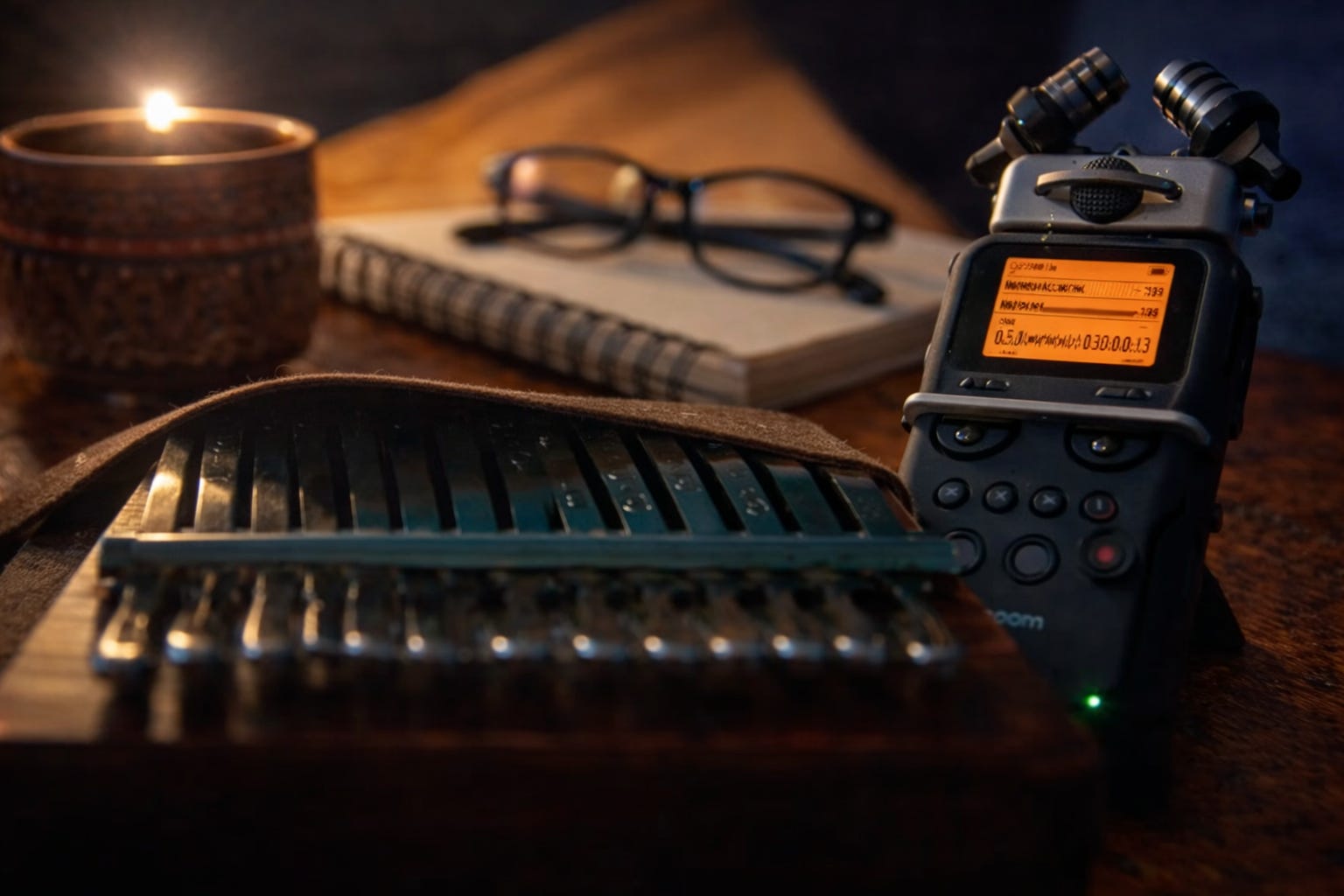
We had been promising to hear the thumb piano. Three chapters in. Several conversations deep. An instrument that has opened doors across four continents, charmed Jane Goodall, and won first place on Brazilian television.
And when David finally held it up to his iPhone and played—nothing came through.
The microphone couldn’t pick it up. The frequency was too quiet, or the angle was wrong, or the technology that lets two men talk across 300 miles of California coastline simply wasn’t built for a 60-year-old instrument made by a patient in a Tanzanian hospital.
David tried repositioning the phone. He tried again. Still nothing. Finally he laughed and said he’d make a recording and send it later.
I sat there thinking: this is the most technologically honest thing that’s happened in the series so far. An instrument that has carried one man’s life across decades, and the screen couldn’t hold its sound.
Some things still require presence.
Where the thumb piano came from—really
In Chapters 1 and 2, the thumb piano appeared as a kind of magic key: the thing David carried into rooms to signal trust. But I hadn’t yet asked the harder question—not what it does, but why it stuck.
This time, David answered plainly.
He arrived in Tanzania in 1965. He was 19 years old. He had taken Swahili courses at Haverford College in Pennsylvania and at a teachers’ training college in Dar es Salaam, but he wasn’t fluent. He certainly didn’t know the local Kinyakyusa language.
And he was alone.
No other Americans nearby. No other “white people” around. He was cooking his own food on a one-burner kerosene stove on the floor. He was carrying water from the river and boiling it to avoid amoebic dysentery. He was washing his clothes by hand on a rack.
“I was feeling pretty insecure,” he said. “So I was looking for a way to create some more security for me, and music was the way to do that.”
He had brought a Gibson guitar from the States. He played an autoharp with a harmonica strapped to a holder so he could play both at once. But the instrument that changed everything was the one he didn’t bring, rather, it was the one he found.
He saw a man at the leprosarium playing an African thumb piano. David asked if he could buy it, and whether the man would be willing to make another. That transaction became the seed of a workshop that eventually produced over twenty different kinds of instruments, run by the patients themselves.
The thumb piano was less a souvenir, than it was a survival strategy born from loneliness and turned into connection. David learned to play it so the people he lived with could hear him trying. And it worked because the effort was legible.
They called him Bwana Marimba—the marimba man. The instrument itself, in the local language, was called the tongo mali. And when David walked through the area playing it, keeping his thumbs in rhythm with his feet, people followed. He compared himself, grinning, to the Pied Piper of Hamelin—”not that I’m trying to get rid of rats or children, but it feels good if somebody’s willing to follow me around while I’m playing it because they like the music.”
The tradition behind the thumb piano carried its own logic: if you can keep a rhythm going with your thumbs and your thumbs don’t get tired, neither will your legs. You can walk long distances as long as you can keep your thumbs moving. Music as engine. Music as endurance.
The night in Dar es Salaam
Not every story about the thumb piano ends with applause.
David was 19, still new to Tanzania, still learning the rhythms of the place. One evening he went out to hear Congolese jazz in Dar es Salaam. He made friends with a bouncer named Simba—lion, in Swahili—and met a Tanzanian woman who asked him to walk her home after the show.
David agreed. He had no intention beyond courtesy. He was playing his thumb piano as they walked through the dark streets.
Then a taxi began circling the block. It circled again. Then it stopped in front of them, and four or five men got out.
They grabbed the woman. They ripped her clothes. They tore the jewelry from her neck. And they took David’s thumb piano—one of his first—and threw it on the ground, where it shattered.
David’s reaction surprised even him. He grabbed one of the men, lifted him into the air, and threw him into the street. He still doesn’t know how he did it. The men jumped back into the taxi and disappeared.
The story could end there—young man, dangerous city, adrenaline—but what David remembered most vividly, decades later, was the rage he felt when they destroyed his instrument. Not the fear for his own body. Not the shock of the confrontation. The instrument.
“Sometimes in your life you’re so emotionally connected to something,” he said, “that if you lose it, you have super strength in terms of how you react.”
I told him I understood. When I was young, my father had lupus and was having a serious reaction. The ambulance was on the way, but our car was blocking the driveway and we couldn’t find the keys. It was one of those old 4x4 wagons with the wood panel siding—heavy as a promise. I pushed it out of the way by myself. I still don’t know how I did it either.
Some emergencies bypass the body’s normal rules. The question is what triggers that bypass: fear, love, or the feeling that something irreplaceable is about to be gone.
The names on the wall
David has a habit of dropping famous names the way other people mention neighbors—casually, mid-sentence, as if proximity to greatness were just geography.
This chapter gave us three.
Bonnie Raitt. David grew up going to the same camps she did. They knew each other as kids. Now, when she comes to Santa Cruz for a concert, David goes to the afterparty and hugs her like a cousin. He says everyone stares: How do you know her? He shrugs.
Ry Cooder. David’s first guitar teacher. They went to the same high school in Santa Monica. Cooder went on to become a legendary musician and filmmaker—his documentary work with Cuban musicians became one of the most celebrated music films of its era. David talks about him the way you’d talk about a lab partner who turned out to be a genius: with warmth, no envy, and a little wonder.
Bob Dylan. This one deserves its own frame.
The cyclist and the rock wall
It was 1972. David had just left a master’s program in public health at UC Berkeley—because he couldn’t handle the boredom.
He told me a story about that departure that says everything about his temperament. A professor named Jim Cunningham was teaching a communications course by reading aloud from his own textbook. David looked around and saw every student in the room falling asleep. So he interrupted: “Hey Jim, I understand you’re an expert on communications theory, but if you just look around the room, you can see everybody’s fallen asleep.”
The professor turned red and left the room. The students woke up and told David to keep his mouth shut—they were just trying to get their credentials. David followed Cunningham to his office and apologized. Cunningham told him he was right, that he should have left the university twenty years ago. He took David to dinner and tried to convince him to stay.
David took a leave of absence and never went back.
He moved in with his mother in Santa Monica and picked up his old exercise habit: racing a Masi Italian bicycle from Santa Monica to Malibu and back, about 35 miles round trip. Crash helmet, special shoes, jersey, pumping hard along the coast.
One day, pedaling through Malibu, he passed a man sitting on a rock wall near a flower shop. Hunched over. Alone.
David rode past. Then he thought: That looked like Bob Dylan.
He kept going. He told himself not to bother the man, it was probably the first five minutes of peace he’d had in years. Then he turned around.
He got off the bike. You could hear the cleats clicking across Highway One. He walked right up and did what David always does: pretended they’d known each other forever.
“Hey, Bob, how’s it going?”
Dylan didn’t look up.
David kept talking. He told Dylan he appreciated his music. He mentioned his instrument collection. He said he was staying at a mansion in Beverly Hills—his brother was caretaking the place, next door to Dean Martin’s house—and invited Dylan to come see his instruments.
Finally, Dylan looked up. David knew then it was really him.
Dylan said four words: “But why me?”
David told him he seemed like a cool guy. He talked about his African thumb piano. Dylan said he knew some guys in Chicago who played thumb pianos. Then he asked: “Have you got a business card?”
David was in a cycling outfit. He did not have a business card.
They parted. David got back on his bike. That was the whole interaction.
He told me he felt sorry for Dylan at the time—his hands were swollen, his health looked rough, he seemed worn down. David thinks it was shortly after Dylan’s motorcycle accident.
When I asked if Dylan might have taken him up on the offer, David said what he always says when a door doesn’t open: “You never know. You never know, right?”
Smoke, feelings, and the trick that worked
Between the big stories, David and I wandered into a conversation about nicotine—how addictive it is, how it hooks you through secondary smoke, how David got hooked as a child because his stepmother smoked a pack a day inside the house.
He smoked unfiltered Camels. He wanted to quit. He went to a psychologist, and she gave him advice that changed the pattern.
She told him: before you light up, notice that you’re probably feeling something—anger, hurt, sadness, fear, love. The nicotine will temporarily numb those feelings. You’ll still have to deal with them later. But if you sit quietly for ten minutes and let yourself feel what you’re feeling, see if you still want to light up after that.
It worked.
That’s a story about the distance between a feeling and a habit—and the ten-minute gap where a different choice lives.
I shared my own version: Marlboro Reds under a Marine cover, not a cowboy hat. Smoking and chewing tobacco on deployments, then stopping cold when I came home to family. David laughed when he asked if I was wearing a cowboy hat. I told him it was a Marine hat. We moved on the way men do when they’ve traded enough vulnerability for one afternoon.
Why this matters
This chapter is about origins—the real ones, not the polished ones.
David didn’t fall in love with the thumb piano because it was exotic or beautiful. He fell in love with it because he was 19, alone, scared, and unable to speak the language of the people around him. The instrument was a bridge he built out of necessity, and he’s been walking across it for sixty years.
That’s the part of reinvention nobody puts on the brochure. Before the confidence comes the insecurity. Before the connection comes the loneliness. Before the story you tell at parties comes the night in Dar es Salaam when someone broke the thing you loved and you found out what you were made of.
If you’re 50 or 60 or 70 and standing at the edge of something unfamiliar—a new city, a new identity, a new room full of strangers—David’s life suggests that the way in is not through credentials or confidence. It’s through something small you can carry, something you’re willing to offer before anyone asks, and the nerve to keep showing up even when the technology can’t capture your sound.
Chapter objects
If Chapter 1 gave us the stage and Chapter 2 gave us the game, Chapter 3 gives us the source:
A one-burner kerosene stove on a floor in Tanzania—the loneliness that made the music necessary.
A shattered thumb piano in Dar es Salaam—the night David learned what he’d fight for.
Cleats clicking across Highway One—the sound of a man deciding to turn around and say hello to Bob Dylan.
A Tupperware container—where David keeps his most valuable instrument, sealed against moisture, stored like something sacred inside something ordinary.
A recording that arrived days later—proof that some sounds don’t travel well through screens, and that the best things in life still ask you to come closer.
And then the sound arrived
A few days after our call, my phone buzzed. David had sent the recording.
I pressed play and heard something I wasn’t prepared for: quiet. The thumb piano doesn’t announce itself. It doesn’t fill a room the way a guitar or a horn does. The notes are soft and metallic, almost liquid—like someone tapping out a message on tiny bells submerged just below the surface of water. Each pluck hangs in the air for a half-second longer than you expect, and the spaces between the notes carry as much weight as the notes themselves.
It’s the kind of sound you lean into. You have to come closer to hear it. And maybe that’s the whole point—maybe that’s why it works as a trust-building instrument. It doesn’t overpower a room. It invites the room to come to it.
I played the recording three times. The third time, I stopped thinking about the series and just listened. The sound is gentle, almost private, and completely at odds with the enormous life it has helped build. Fifteen thousand people at the Berkeley Folk Festival. Brazilian television. Jane Goodall’s smile. Bob Dylan’s “But why me?” All of it started with a sound this soft.
Where we go next
Next week, I want to go deeper into Tanzania. Three years is a long time to live inside someone else’s world. I want to know what David carried home that he couldn’t put in a suitcase—and what he left behind that he still reaches for.
Because now I’ve heard the instrument. And the longer we talk, the more I realize this series is about one man’s extraordinary life and about the ordinary materials extraordinary lives are made from: loneliness, nerve, a broken instrument, a psychologist’s advice about sitting with your feelings, the willingness to pedal past Bob Dylan and then turn around—and a sound so soft you have to come closer to hear it.
Thanks for reading! Subscribe for free to receive new posts and support my work.
About the Author
Jerry W. Washington, Ed.D., is a Marine Corps veteran of twenty-three years and co-founder of Betweenward, a space for people building what comes next when the old method has stopped working. He also publishes What Time Binds on Substack, where he writes on institutional accountability and public memory. He holds a doctorate in Organizational Change and Leadership from USC Rossier, teaches at UC Irvine’s Division of Continuing Education, and is the author of Adulthood of Humanity (2026).