


Ruth wakes at 6:10, as she has for twenty-two years, and reaches for her phone before her eyes fully open. There’s nothing on it. Last Friday, she handed the nonprofit she founded to a successor she chose, and the handoff went better than she’d hoped. She makes coffee and stands at the kitchen window, holding the mug with both hands, listening for a question that isn’t coming.
For four years, Marcus set his alarm by his mother’s pill schedule. In August, she moved into assisted living across town, where the staff now handle her medications and the calls in the middle of the night. His body still wakes him at 5:45. He visits most afternoons, and she’s always glad to see him, but on the drive home he can’t shake the feeling that he’s been demoted to guest.
Lena came back to work in September after eight months of treatment. Her old job, running a team of forty, was waiting for her, and her boss made sure she knew it. She turned it down, asked for a smaller role with saner hours, and hasn’t regretted it once. Still, at Thursday’s all-hands, when her former team’s results go up on the screen with someone else’s name beside them, she claps along with everyone else and feels, for the first time in years, like a spectator.
Each of them would tell you they’re where they want to be. And all three ask the same question, often at odd hours and mostly to themselves: If I’m not running something, do I still matter?
Where mattering used to live
For people who have always been the capable one, mattering and being in charge have usually shown up together. The role answered the question before anyone thought to ask it because people brought you the hard problems, and decisions waited for your yes.
Most of the evidence was built into the structure: your name on the invite, and the meeting waiting for you to show up. Nobody had to say you mattered, because the calendar said it for you.
So when the role goes, whether you chose to leave it or it ended without asking you, the question it used to answer comes to the surface, sometimes for the first time in years. And the most natural conclusion is the one all three are half-drawing: to matter again, I’d need to be running something again.
The two halves of mattering
Researchers have a name for what the role was supplying. Morris Rosenberg and B. Claire McCullough introduced the idea of mattering in 1981, describing it as feeling important to other people.1
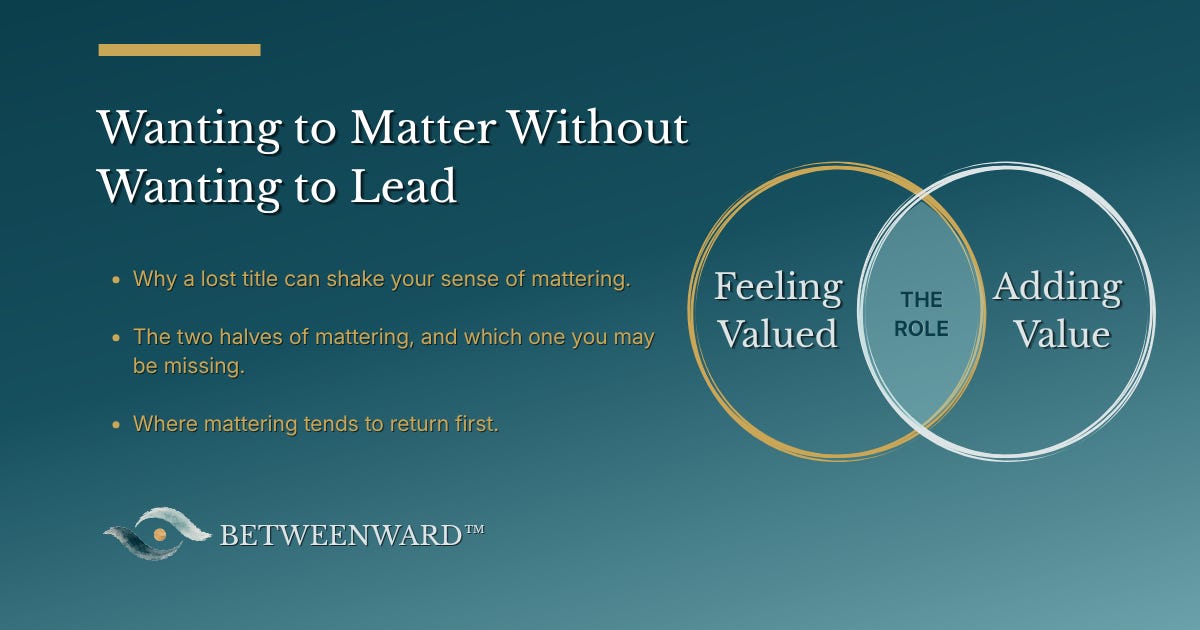
Psychologists Isaac and Ora Prilleltensky, authors of How People Matter, give the idea a shape that’s especially useful here. “Mattering consists of feeling valued and adding value,” they write, “to ourselves and others.”2,3
A leadership role delivers both halves in one package. People value you for the role, and the role gives you a built-in way to add value every day. The halves come bundled, so you rarely have reason to tell them apart. But when the role ends, both leave with it, and it’s easy to assume the only way to get them back is another role like the last one.
Why it reaches so deep
In 2024, a team led by psychologist Monica Paradisi pulled together 30 published reports on mattering, covering more than 18,000 people. Across them, people who felt they mattered tended to report higher well-being, and the strongest connection was with the kind of well-being that comes from meaning and purpose. The link held regardless of age or gender.4
That last finding is worth sitting with if you’re in the in-between. The need to matter outlasts any title you’ve held, and it stays with you at every point in a life.
Which half is missing
Seeing the two halves opens up a more useful question: which one is missing?
The answer differs from person to person, which is part of why the old conclusion misleads. Ruth is still valued. Her board gave her a lovely send-off, and the thank-you notes keep coming. What she’s missing is the daily chance to put what she knows to work.
Marcus spent four years adding value every hour of the day while almost no one noticed, so he has lost a half he barely had. Lena still adds value in her new role, but the person with the title got the recognition, and she misses being seen more than she expected.
For many capable people, the second half leaves the bigger hole. Being thanked for what you’ve done feels different from being needed for what you can do. When people tell you you’ve earned your rest, they mean it kindly, and it can still land like being shown the door.
That second half needs a place for your experience to land, and someone to receive it. A title is one way to arrange both, and it’s only one.
Rosenberg later drew a distinction that helps here. He separated mattering to particular people, the ones who would notice if you stopped showing up, from mattering to society at large.4 Both are real forms of mattering. Capable people tend to measure their contribution the way their jobs taught them to: in scale and in results someone could put on a slide; by that measure, helping one person can feel too small to count. Rosenberg’s distinction puts the two side by side, and the person receiving your help would never call it small.
Where it turned up
In the third week, Ruth’s successor calls with a question about a longtime donor. Ruth answers it in ten minutes and hangs up feeling something she can’t name at first. She wasn’t deciding anything. She was helping, and it felt like the best part of the old job, with the weight lifted. Before the week is out, she tells her successor to call anytime about donors, and she means it.
Marcus waits in the lobby one afternoon when a woman moving her father in sits beside him, holding a folder of medication forms and looking the way he must have looked four years ago. He spends forty minutes walking her through it, and on the drive home, he doesn’t feel like a guest.
A junior colleague asks Lena to look over her slides before the next all-hands. Lena spends an hour on them, mostly asking questions. When the presentation goes well, she claps along with everyone else, and this time she feels part of the room.
Each is small, and none settles the question for good. They point in a direction, though. In The Ripple Journey™, this is the Outer Wave: the stage where your experience serves others without forcing it, and the value you carry finds its use.
Mattering often comes back this way, one person at a time, long before anyone offers you another title.
Ask yourself: Which half of mattering have you been missing, feeling valued or adding value? And where might the one you’re missing already be within reach?
P.S. If you’re in the in-between and want a room to name it, join me for Between Currents™ on October 21. It’s free and live. Details here.
Research cited
¹ Rosenberg, M., & McCullough, B. C. (1981). Mattering: Inferred significance and mental health among adolescents. Research in Community and Mental Health, 2, 163–182.
² Prilleltensky, I., & Prilleltensky, O. (2023, November 13). Knowing that you matter promotes health and happiness. University of Miami News. https://news.miami.edu/stories/2023/11/knowing-that-you-matter-promotes-health-and-happiness.html
³ Prilleltensky, I., & Prilleltensky, O. (2021). How people matter: Why it affects health, happiness, love, work, and society. Cambridge University Press.
⁴ Paradisi, M., Matera, C., & Nerini, A. (2024). Feeling important, feeling well: The association between mattering and well-being. A meta-analysis study. Journal of Happiness Studies, 25, Article 4. https://doi.org/10.1007/s10902-024-00720-3 (also the source for Rosenberg’s later distinction between interpersonal and societal mattering)
María Tomás-Keegan is a career and leadership coach, award-winning author, and trusted guide for people moving through meaningful change in work and life. Through her coaching, writing, and speaking, she helps people reconnect with who they are now, trust the wisdom they’ve earned, and lead forward with clarity, courage, and alignment. She created The Ripple Journey™, a framework for transforming work and life, and co-founded Betweenward™ with Jerry W. Washington, Ed.D. Her articles’ client stories are composites of several people she has worked with over the years, with details changed to protect their privacy.