


I don’t know if you’ve been here, but if you have, I want you to know I see you.
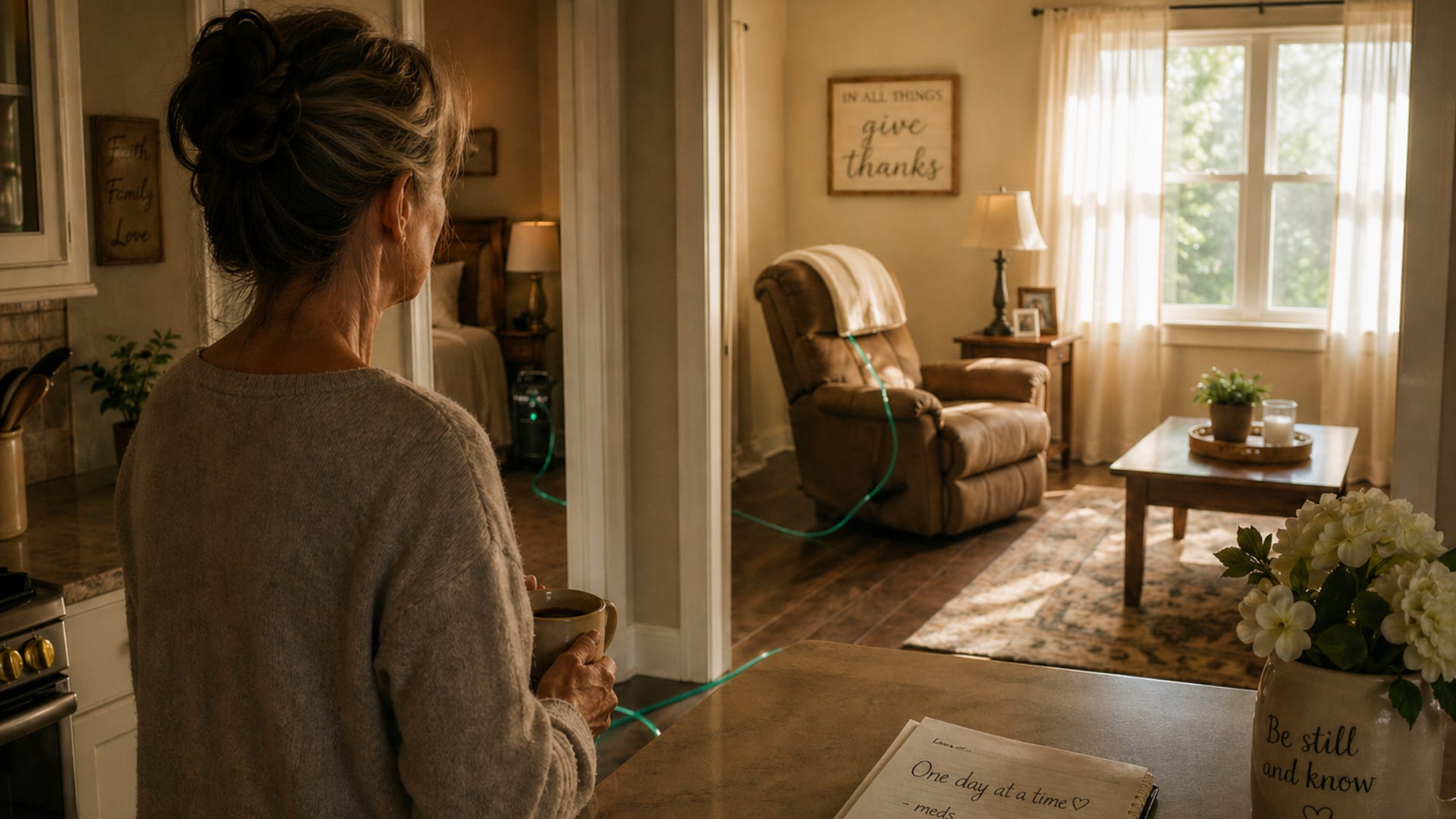
One morning, I stood in my kitchen and saw the green tubing running from our bedroom into the living room. My husband was still sleeping, and the house was still. The tubing was there so he could move from oxygen in bed to oxygen in his chair when he was ready.
That was the moment it all landed differently.
We’ve been living with health challenges for a long time, so this caregiving journey didn’t begin yesterday. We’ve had diagnoses, adjustments, and new routines before this one. But this was different. This diagnosis, layered on top of several others, brought his mortality into plain view in a way I couldn’t ignore or soften in my mind. I couldn’t make it simply another appointment, medication, or small shift in the day.
Something about that green tubing made the change obvious.
I heard myself say to a friend, “This feels like the beginning of the end.”
Even writing those words now, I feel the weight of them. And maybe that’s part of what makes caregiving so hard to talk about. We don’t always have the right words for what’s happening while we’re in the middle of it. We’re managing equipment, appointments, medications, instructions, phone calls, and decisions. We’re adapting the house, the calendar, and the day’s rhythm. Underneath it all, we’re also carrying the emotional truth of what has changed.
When Love Asks for Something Different
I’ve been my husband’s wife for more than 30 years. I’ve been his partner, his companion, his person. We’ve built a life with all the ordinary and extraordinary things that make a marriage what it is. And laughter has always been part of us. So has honesty, and getting through things we didn’t expect.
Over the years, my role has changed many times. Lover, wife, partner, advocate, caregiver. Some days, those roles blend so completely that I don’t know where one ends and the other begins.
That’s the part many people don’t see. Caregiving doesn’t only change what you do. It changes how you listen, how you watch, how you sleep, and how you move through the house. It also changes how quickly your mind goes to the next practical question.
Is he breathing comfortably? Did the new medication help? What does that symptom mean? Will this treatment make things better, harder, or both? How is he really doing with all of this?
And then, somewhere underneath those questions, another one starts to surface: How am I doing with all of this?
That first week after the new diagnosis, I was on high alert — watching for signs that he was struggling with the new routine, and for changes in his breathing. I watched how he moved, how he rested, and how he responded. The future felt uncertain in a way I couldn’t easily name, and the questions kept circling. How would he adapt to this new reality? How would I?
The Conversations That Steadied Us
As the days passed, we began having the conversations that needed to happen. They weren’t grand, but they were real. The ones that come when you’re standing in the middle of something you can’t change and trying to decide how you’ll live with it.
We talked about acceptance and about how we couldn’t change this new situation, only how we would respond to it and build our days around it. We talked about gratitude, too, because even though his body is breaking down in ways we wish it weren’t, his mind is still sharp. That matters. Every. Single. Day.
And we talked about wanting to make the best of our time together, whatever that time turns out to be.
Those conversations didn’t make everything easier, but they did make things more honest. Something about telling the truth together feels very grounding. It doesn’t remove the grief or the fear, or answer every question. But it keeps you from standing alone in the middle of what has changed.
Then, sometime during that first week, his humor came back.
He looked at me with that familiar smirk and said, “At least now I can breathe easy, and I won’t take it for granted.”
There he was. That was my thought. There he is.
I can’t tell you how grateful I was for that moment. He could have chosen anger and turned it toward the situation, the equipment, life, even me. And I would have understood. Instead, my hubby chose to ride this rollercoaster with me the way we’ve ridden so many others, laughing with our hands in the air, sliding into home base with a smile.
That doesn’t mean we’re pretending this isn’t hard. It means we’re still us inside it.
The Ripple Starts Again
I often talk about the Ripple Journey because transitions rarely move in a straight line. Something happens; I call it The Drop, disrupting what had become familiar. Then the waves begin again.
This new diagnosis was another Drop in a long caregiving journey. It changed the room, the routine, and the way the future felt when I looked toward it. The Inner Wave was the pause we both had to take, the honest conversations, the acceptance that life had shifted again, and the tenderness of admitting what we could and couldn’t control.
The Middle Wave came through the people who knew what to do next. Medical experts helped us understand the equipment, explained how it worked, how to navigate with it, and how to integrate it into daily life without letting it take over every corner of our home.
The Outer Wave came through my dearest friends. They listened and acknowledged how hard this was. They gave me room to feel it without rushing me toward a brighter interpretation. They prayed with me and let me cry. And they helped me return to the practical steps I could take, one day at a time.
Sometimes support looks like advice. This time, it looked more like presence.
Slowly, Still Water began to return. It wasn’t that everything was fine, or that the fear disappeared. It returned because we began to settle into the new normal and make the best of it. We learned where the tubing needed to go and how to move around it. We adjusted to what the day required now. And we began to breathe again inside what had changed.
For the Ones Carrying This Quietly
I’m sharing this because I know there are so many of us moving through seasons like this in silence. We bear it, adjust to it, and love through it. We watch as we keep living inside what has changed, even when we don’t always have words for how much it has changed us.
Some are caring for spouses, aging parents, adult children, siblings, friends, or neighbors. Some are sandwiched between generations, tending to growing children on one side and aging loved ones on the other. Many of us do it while still working, leading, showing up, answering emails, keeping commitments, making dinner, paying attention to everyone else’s needs, and wondering when we’re allowed to admit we’re tired.
Caregiving can be full of love, and it can also be lonely. Both can be true at the same time.
And when your role changes, it can shake something deep inside you. You may still be a wife, husband, daughter, son, parent, friend, or partner, but the way you inhabit that role may feel different now. More watchful. More responsible. More tender. More aware of time.
That kind of change deserves a name.
We don’t always know how we’ll respond when The Drop hits. I didn’t. I don’t think most of us do. We find out in real time, often while we’re trying to understand instructions, make decisions, and keep our hearts from running too far ahead.
For me, leaning into my faith is the best thing I can do. I lean in big, deep, and hard because that’s where I find enough steadiness for the next step. For you, it may be faith, too. Or friendship. Or therapy. Or prayer. It might be a walk outside, writing in a notebook, or reaching out to the community that lets you tell the truth — or it could be one trusted person who can hear you say the thing you’ve been holding back.
Whatever steadies you, lean in. You don’t have to carry this season without support or make your courage look polished. And you definitely don’t have to rush yourself past the ache just because other people don’t know what to say.
Still Water isn’t a place where nothing changes. It’s where we learn to breathe again inside what has changed.
That’s where we are right now, my husband and I, living inside a reality we didn’t choose. We laugh when we can, tell the truth when we need to, and make the best of the time we have.
And adapt again, one day at a time.
María Tomás-Keegan is a career and leadership coach, award-winning author, and trusted guide for women moving through meaningful change in work and life. Through her coaching, writing, and speaking, she helps women reconnect with who they are now, trust the wisdom they’ve earned, and lead forward with clarity, courage, and alignment. She created The Ripple Journey™, a framework for transforming your work and life. She is a co-founder of Betweenward™.