


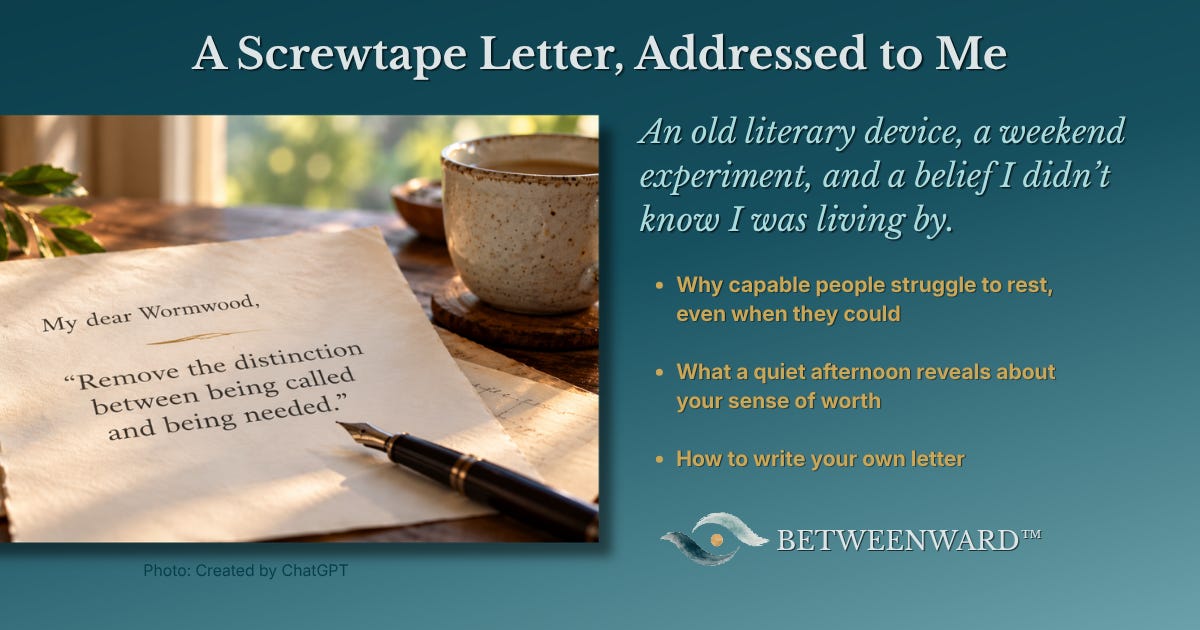
Over the weekend, a Bible study prompt sent me somewhere I didn’t expect. It drew on C. S. Lewis’s The Screwtape Letters, first published in 1942, a series of letters from a senior demon named Screwtape to his nephew Wormwood, coaching him on how to lead a person away from God. What makes the book unsettling is that Screwtape rarely recommends anything obviously wrong. He prefers to work through what’s good.
So I tried an experiment. I asked ChatGPT, which knows a fair amount about my life and work from our conversations, to write a Screwtape letter about me. My question came straight from that study: how might I be pursuing good things for God while forgetting to pursue them with Him?
What came back was uncomfortably personal, and you don’t have to share my faith to recognize yourself in it.
My first thought after reading it was how I could turn it into something useful for you. Then I noticed this reflex was exactly what the letter described.
Called, or needed
Screwtape starts with my work.
“She sees possibilities everywhere. An article that might encourage someone. A conversation that could change a life… Whisper that the work is important. Remind her of those who need what she has to offer.”
Then comes the instruction that stopped me: “remove the distinction between being called and being needed.”
It’s true. I see possibilities everywhere, and nearly every one of them looks like something I should do. An idea for an article turns into a draft. A conversation with someone in transition becomes a plan for how Betweenward™ might help people like them. All of it is good work, which is what makes the line so sharp.
Being needed feels like being called. Both feel urgent, and both tug at the part of me that has always wanted to help. The difference is that a calling is mine to answer, while a need can belong to anyone who notices it. When I stop telling them apart, every need I notice becomes an assignment.
I did this exercise on Sunday. I’m writing about it the evening before it publishes, and that delay is part of the story.
One belief, every room
The longer I read, the more I saw one belief running underneath every paragraph: that I have to earn my worth by being useful.
Peace is where it first hides. Screwtape advises Wormwood, “Whenever she finds a moment of peace, remind her of something she may have forgotten to worry about.”
Receiving is harder still. “Discourage her from needing what she so generously offers,” he writes, and then he lists the excuses I already use: other people have enough troubles of their own, and I’m fortunate compared with others.
Time gets the same treatment. Screwtape wants the years ahead to feel “less like an invitation to cherish the present and more like a deadline she dare not miss.”
Each of these is the same belief in different clothes. If my value comes from what I contribute, a quiet afternoon is wasted, and accepting help feels like a debt.
Why the pause feels like failure
This belief runs through nearly everyone I’ve coached in the in-between, whatever they believe about God. Coaching people through this pattern has made me quicker to recognize it in myself, though I’m not immune.
In The In-Between Isn’t a Waiting Room, I wrote that capable people tend to misread the pause between chapters as personal failure. Screwtape’s letter showed me why. A pause produces nothing. If your worth comes from what you produce, the pause feels like losing your worth.
Two weeks ago, I wrote about the two halves of mattering: feeling valued and adding value. The letter showed me a capable person who lets the second half stand in for the first. Too often, I feel valued only while I’m adding value.
What Screwtape feared I’d find
Near the end, Screwtape names what he fears most. His patient might discover:
“That trust sometimes looks like leaving an important thing unfinished… That faithfulness may require her to disappoint someone, decline an opportunity, or allow another person to carry a responsibility she could have managed herself. Worst of all, she may discover that she is loved even when she produces nothing, solves nothing, improves nothing, and helps no one.”
That last line is the one I’m still sitting with. For readers who don’t share my faith, I’d put it this way: you matter on the days you produce nothing.
I believe that about every client I’ve worked with. Believing it about myself takes a different kind of practice, and this week gave me a small chance to try it. Since Sunday, I reread the letter several times. Every instinct I have said to turn it into an article right away. Instead, I let the idea wait until I was ready to share it, which is why you’re reading something I finished the evening before I published it.
Write your own letter
Anyone can try this. Find a quiet half hour and a notebook, and start with one question:
If someone wanted to wear you down using only your best qualities, how would they do it?
Then, if you want to go further:
• What am I carrying that no one asked me to carry?
• Where have my strengths turned into obligations?
• Am I offering myself the same patience I offer others?
If you use an AI assistant that already knows something about your life and work, you can ask it to write the letter, the way I did. Here’s a version of my prompt to adapt:
Inspired by C. S. Lewis’s The Screwtape Letters, write a letter from Screwtape to Wormwood imagining how my strengths and good intentions might wear me down or pull me away from what matters most to me. Draw only on what you know about me, and don’t invent details. Make it thoughtful and specific, not harsh.
If faith is part of your life, you can ask the question the way I did. Whatever comes back, treat it as a mirror. It can only reflect what you’ve shared, and you decide what’s true in it.
And yes, I noticed the irony of turning this into an article anyway. I’m letting that one go.
Ask yourself this: Where have you mistaken being needed for being called?
Sources
Lewis, C. S. (1942). The Screwtape Letters. Geoffrey Bles.
Letter excerpts are from a Screwtape-style letter ChatGPT (OpenAI) generated for the author, October 2026.
María Tomás-Keegan is a career and leadership coach, award-winning author, and trusted guide for people moving through meaningful change in work and life. Through her coaching, writing, and speaking, she helps people reconnect with who they are now, trust the wisdom they’ve earned, and lead forward with clarity, courage, and alignment. She created The Ripple Journey™, a framework for transforming work and life, and co-founded Betweenward™ with Jerry W. Washington, Ed.D.
I've always found my peace at the center of knowing that my worth is divinely inherent and still, Screwtape is insidious. He finds a small divit in our belief system and pounces. Your article points out so well the way that our thoughts can derail our best efforts if left unexamined.