


Clara had been out of work for five weeks when she finally said it out loud. She was at dinner with a friend she’d known since their first jobs, and the friend asked the question everyone asked: “So what’s next?”
Usually Clara had a quick answer ready, something about taking a few months and seeing what turned up. This time she set down her fork and said, “I don’t know, and that’s new for me. It scares me a little.”
Her friend leaned in. Within a minute, she’d offered the name of a recruiter she trusted and a standing invitation to go over Clara’s résumé that weekend. Clara thanked her, and she meant it. Both offers were generous.
On the drive home, though, she felt lonelier than she had before dinner, and she couldn’t figure out why.
Part of what bothered her was that she recognized her friend’s move because Clara had done it herself with colleagues and family for years. They called her when they needed advice, and she was good at it.
Why the fix comes so fast
If you’ve always been the capable one, you know the pull. Someone starts describing a problem, and before they’ve finished, your mind is already solving it. It feels like you’re helping, and most of the time you are.
Research suggests it also feels good for another reason. In 2018, a team led by management researcher Michael Schaerer published four studies on what giving advice does for the person who gives it. In one, people who recalled a time they’d given advice reported feeling more powerful than people who recalled an ordinary conversation, whether or not the advice had been requested. In another, people who gave advice more often felt a stronger sense of power, especially when others usually followed that advice. The researchers concluded that advising someone gives the adviser a feeling of influence over what happens next.¹
That boost had a condition attached. It showed up when the advice was taken and faded when it was rejected.
Anyone whose sense of self rests on being the one who solves things will recognize this. The fix comes fast because it steadies the fixer. It’s also why a friend’s honest “I don’t know” can be hard to sit with. Offering a solution gives everyone at the table something to grab onto.
Help you didn’t ask for
The person on the other side of the table has a different experience.
In a 2003 workplace experiment, Dutch researchers led by Jaap Deelstra found that help people hadn’t asked for generally drew negative reactions, even when they needed it.² Two decades later, a German team led by Anika Schulz found a related pattern in employee surveys: the more unwanted help people got at work, the more frustrated they felt about their control over their own work and their sense of competence, and the frustration over control followed them home.³
Together, these studies point to what Clara felt on the drive home. Unrequested help, however generous, can tell a capable person that someone else has decided what they need.
A fixer from the start
I know both sides of that table well.
For as long as I can remember, friends and siblings have brought me their problems, and I've gone looking for solutions. In my leadership roles, I was the go-to person when a client relationship or an internal team hit trouble. Running my own business, I’m the one who works through everything, because there’s nobody else to do it.
Coaching asked something different of me. I had to learn that my clients’ problems are theirs to solve. Listening became a skill I built on purpose, along with asking questions that help people test their own options and choose the ones that fit their values.
The urge to fix still shows up; don’t get me wrong. But these days I notice it sooner, and more often than not I approach it differently.
What listening does instead
Psychologist Guy Itzchakov and his colleagues have spent years studying what good listening does for the person being heard. In a set of experiments published in 2018, people shared their views on a topic with a listener. Some listeners were attentive and engaged. Others were distracted, glancing at messages or a screen the speaker couldn’t see.
People who talked with an attentive listener felt less socially anxious. They became more reflective about what they thought, and came away clearer about their own views. In these studies, the clarity came from the quality of the listening.⁴
For someone walking through the in-between stages of their life or career, that kind of clarity is often what’s missing most. The planning and problem-solving that always worked have stopped producing answers, and what helps is someone who listens long enough for you to hear yourself think.
In The Ripple Journey™, the framework I created for moving through change, I call it the Middle Wave: someone who has stood where you’re standing and witnesses what you carry without trying to fix it. A well-meant fix can skip right past it.
The second conversation
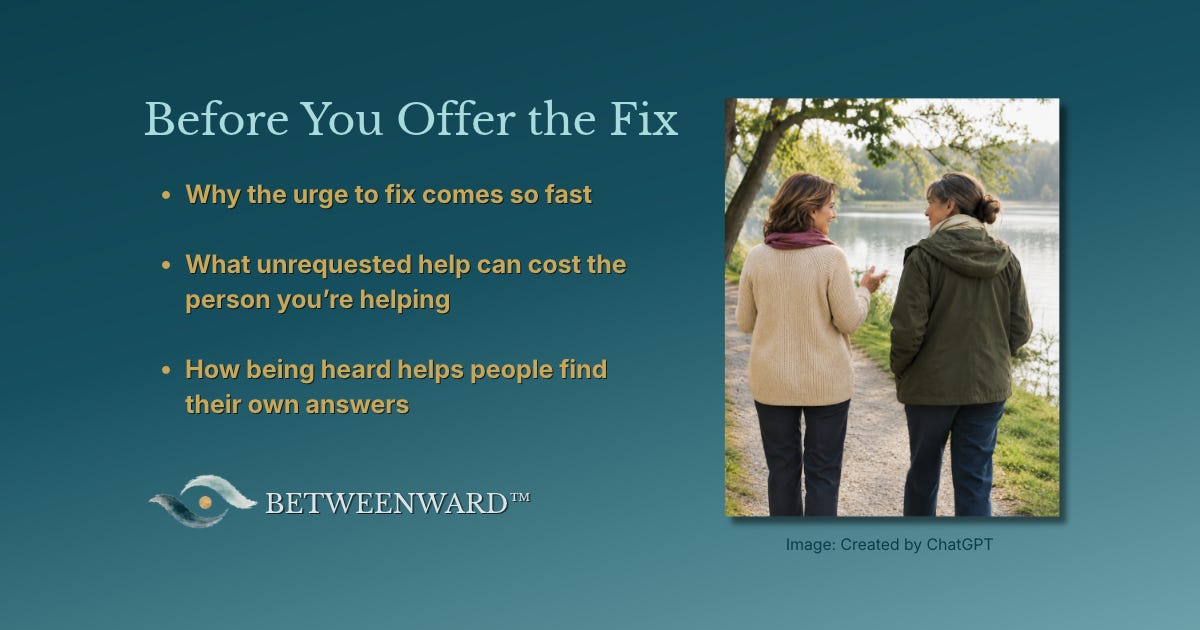
A few weeks after that dinner, a neighbor who had sold her own business two years earlier asked Clara to join her on a morning walk. Halfway around the lake, the same question came up, and Clara gave her usual answer about taking a few months, then stopped. “Honestly,” she said, “I don’t know what I want, and I’ve never been here before.”
Her neighbor nodded. “What’s it been like?”
They walked the loop twice while her neighbor asked a handful of questions and offered no advice at all. Somewhere in that conversation, Clara heard herself say that she’d loved building teams far more than she’d loved the work the teams did. She’d never put it that way before, even to herself.
Clara left with one clear thought she hadn’t had until that morning, and for now, that was enough.
Ask yourself this: When someone you care about says “I don’t know,” what is your first response?
Know someone who’s always the first with a solution? Send this their way.
P.S. If you’d like to be in a room where you can say what’s shifting before anyone tries to solve it, join me for Between Currents™ on Wednesday, November 18th. It’s free, live, and the last session of 2026. Learn more and save your spot here.
Research cited
¹ Schaerer, M., Tost, L. P., Huang, L., Gino, F., & Larrick, R. (2018). Advice giving: A subtle pathway to power. Personality and Social Psychology Bulletin, 44(5), 746–761. https://doi.org/10.1177/0146167217746341
² Deelstra, J. T., Peeters, M. C. W., Schaufeli, W. B., Stroebe, W., Zijlstra, F. R. H., & van Doornen, L. P. (2003). Receiving instrumental support at work: When help is not welcome. Journal of Applied Psychology, 88(2), 324–331. https://doi.org/10.1037/0021-9010.88.2.324
³ Schulz, A. D., Fay, D., Schöllgen, I., & Wendsche, J. (2024). When help is not wanted: Frustrated needs and poor after-work recovery as consequences of unwanted help at work. Stress and Health, 40(5), e3415. https://doi.org/10.1002/smi.3415
⁴ Itzchakov, G., DeMarree, K. G., Kluger, A. N., & Turjeman-Levi, Y. (2018). The listener sets the tone: High-quality listening increases attitude clarity and behavior-intention consequences. Personality and Social Psychology Bulletin, 44(5), 762–778. https://doi.org/10.1177/0146167217747874
María Tomás-Keegan is a career and leadership coach, award-winning author, and trusted guide for people moving through meaningful change in work and life. Through her coaching, writing, and speaking, she helps people reconnect with who they are now, trust the wisdom they’ve earned, and lead forward with clarity, courage, and alignment. She created The Ripple Journey™, a framework for transforming work and life, and co-founded Betweenward™ with Jerry W. Washington, Ed.D. Her articles’ client stories are composites of several people she’s worked with over the years, with details changed to protect their privacy.