


The meeting was on Dana’s calendar as a fifteen-minute check-in. It ran forty.
By the end, she knew three things. The division was being folded into another one. Her role would end in six months. And leadership wanted her to run the transition: move the projects, place the people who could be placed, and keep the work steady right up to the last day of a job she’d spent eleven years building.
“Honestly, there’s nobody else we’d trust with this,” the VP said.
Dana said yes before the sentence was finished. By then, saying yes was a reflex, as automatic as reaching for a pen. Somewhere between the conference room and the parking garage, the math of it landed: six months of carefully taking apart her own work, with a team watching to see how she handled it.
That night, a text from her brother lit up the phone. Their mother’s lease was ending, and the family needed to decide about a move. “You’re so much better at this stuff than I am. Can you take the lead?”
She typed, “Of course,” and set the phone face down on the counter.
Nobody in either conversation had done anything wrong. The VP meant it as a compliment, and so did her brother. Both of them were right, too. Dana was good at this, and always had been. That was the whole problem, though it would take a while to see it.
Nobody decided this
If you’d asked anyone at her company when Dana became the person who handles the hard things, no one could have named a day. It was never a decision. A tricky client went to her once, then again. New hires who needed patience got routed her way. One spring the budget process fell apart; she pulled it back together, and after that the budget belonged to her. Each handoff made sense on its own, and she said yes to every one. Over eleven years, it all added up to a job description nobody ever wrote down.
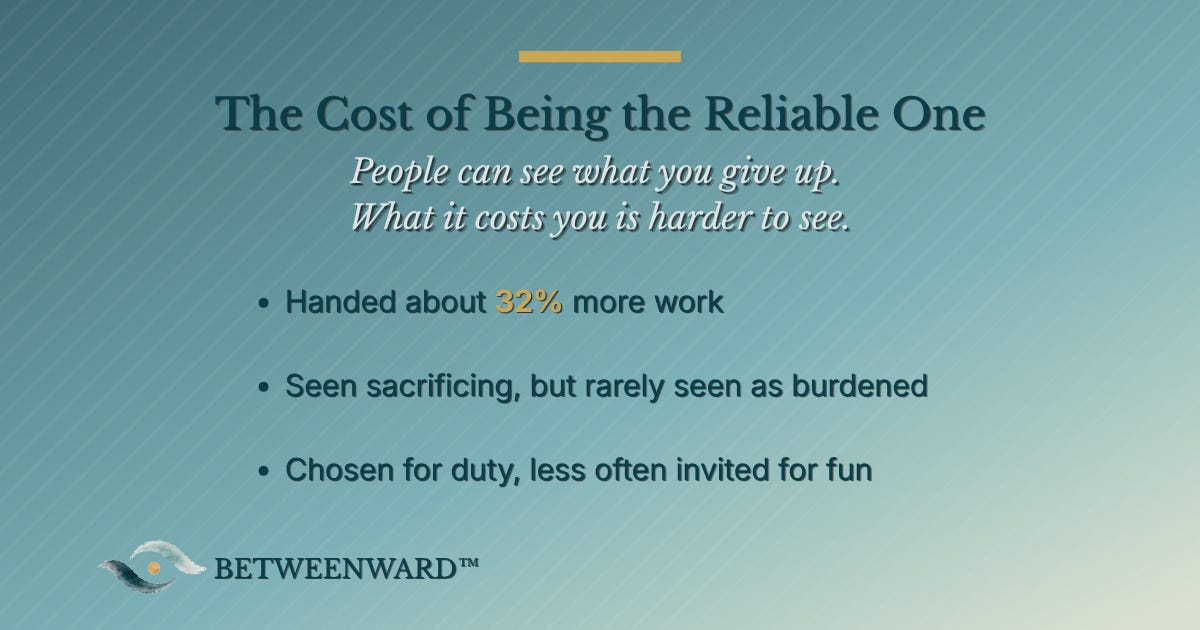
Researchers have tested this instinct in its simplest form. In a 2015 study published in the Journal of Personality and Social Psychology, a team led by psychologist Christy Zhou Koval gave people ten essays to divide among four mentors who differed only in how much self-control each had shown in everyday life. The most disciplined mentor ended up with about 32% more essays than the least disciplined one.¹
Nobody in that study meant to overload anyone. Giving the extra essay to the disciplined mentor felt like good judgment. That’s what makes the pattern so hard to see from the inside, because every single choice to lean on the reliable one looks reasonable. The weight shows up only in the total.
Calm under pressure
A month into the wind-down, Dana’s annual 360-degree review came back. The timing felt almost funny: feedback on a job that was ending.
The comments were glowing. Calm under pressure. Never drops a ball. The person everyone goes to. One colleague wrote that she made hard things look easy. She read that line twice.
Hard things did not feel easy. For weeks Dana had been sleeping badly, waking at four to go over which team members still needed placements. She wrote transition plans at night and handled her mother’s move on weekends. None of that showed up in the feedback. Not one colleague had noticed she was tired.
This is the part of the research that stays with me. In another 2015 study, Koval’s team gathered 360-degree feedback on 403 working MBA students from more than 2,200 coworkers and supervisors. The employees with high self-control reported making real sacrifices and feeling burdened by how much others relied on them. Their colleagues saw the sacrifices clearly. What they missed entirely was the burden.¹
That’s what Dana’s colleagues saw. Every ball she kept in the air looked like proof she had room for one more.
You’ve got this
At home, things were good. That was part of what made it hard to explain.
Dana and her partner had been together long enough to finish each other’s grocery lists. When she came home the night of the meeting and told the story, her partner listened, poured two glasses of wine, and said what the people who love her always say: “You’ve got this. You always do.”
It was meant as faith, and she took it that way. Still, lying awake at four the next morning, she noticed something she didn’t want to say out loud. Even at home, she was the one who had it: the mortgage refinance, the vet appointments, the holiday plans, and now her mother’s move. Nobody had assigned any of it. Each piece had drifted to her the same way the budget had at work.
Koval’s team found this pattern at home, too. In a study of 139 couples, people with high self-control actually reported happier relationships overall. They also felt their partners relied on them more, and that reliance left them worn out from helping. The fatigue wore down their satisfaction, even in relationships that were working.¹
Being the one who always has it costs something, even when the person counting on you loves you.
Picked for the work
The last big event before the division closed was a farewell lunch for the team. Dana planned it, of course. She booked the room, collected money for the cake, and wrote a toast that made two people cry.
Afterward, a handful of her team headed to a bar down the street. She heard about it the next morning, mentioned casually, the way people mention things they assume you already know. Nobody had meant to leave her out. One person said they figured she’d be buried in transition work. Another didn’t think it was really her thing.
She laughed it off, and it stung all day.
A 2021 study by a team that included social psychologist Roy Baumeister helps explain what happened. The researchers gave 285 adults short descriptions of people with high or low self-control and asked whom they’d want along in different situations. For duties and obligations, participants chose the person with high self-control. For vacations and parties, they tended to prefer the one with less.²
Dana spent years being chosen. It never occurred to her to notice what she wasn’t chosen for.
I’ve always known
The company offered outplacement coaching as part of the transition package, which is how Dana ended up in my virtual office. She canceled twice. There was too much to do.
I should say here that Dana isn’t one person. She’s several clients I’ve worked with over the years, woven into one story, with more than a little of me in her, too. If she sounds like someone you know, that’s the point.
About twenty minutes into our first conversation, after she’d walked me through the transition plan, the placement list, and her mother’s move, I asked what she wanted next for herself.
She was silent for a long moment. “I don’t know,” she said. “And I’m embarrassed that I don’t. I’ve always known.”
That sentence is the one I hear most from people like Dana. They have spent years being the answer to everyone else’s problems, and when the question finally turns to them, the silence feels like failure. That silence is the in-between: the stretch after what was and before what’s next, where the old tools of planning, follow-through, and the reflexive yes have nothing to hold on to.
I’ve written before that this pause isn’t a waiting room. For the reliable one, it’s also the hardest room to stand in, because everyone around her is still handing her things to carry. Her reputation leaves no room for the pause, and neither does she. The work of the Inner Wave, letting what’s ending actually land before reaching for what’s next, might look like Dana dropping a ball.
For the first time in eleven years, that might be exactly what she needs to do.
One honest sentence
A few weeks later, Dana had coffee with Ray, a former colleague who had lost his own role in a reorganization two years earlier. She’d helped him rework his résumé back then.
He asked how the wind-down was going, and she started into the version she’d been giving everyone: on track, team in good shape, a few placements left. But she stopped herself halfway through.
“Actually,” she said, “this one is hard for me.”
Ray didn’t offer a plan or a pep talk. He nodded and said, “Yeah. Mine was too. What’s the hardest part?”
She talked for most of an hour. Nothing got solved, but she drove home feeling lighter anyway.
That’s the Middle Wave: someone who has stood where you’re standing, witnessing what you carry without trying to fix it or take it off your hands. For the reliable one, it’s also practice at something that doesn’t come naturally: letting someone see the cost, not only the output.
That weekend, Dana called her brother. She told him she couldn’t lead their mother’s move alone this time and asked him to take on the housing research. There was a pause on the line, and then he said, “Of course.”
She still doesn’t know what’s next. Somewhere along the way, though, she stopped treating that as a problem to solve by Friday.
If you’re the reliable one
When Koval returned to this research in an essay earlier this year, she noted that the demands on capable people pile up across work and home at once.³ More than a decade after her first study, the pattern she found is as familiar as ever.
You don’t have to stop being the reliable one. It may be enough to let one person see what it costs.
Is there a Dana in your life? Send this their way. It may be the first time someone noticed.
Research cited
¹ Koval, C. Z., vanDellen, M. R., Fitzsimons, G. M., & Ranby, K. W. (2015). The burden of responsibility: Interpersonal costs of high self-control. Journal of Personality and Social Psychology, 108(5), 750–766. https://doi.org/10.1037/pspi0000015
² Röseler, L., Ebert, J., Schütz, A., & Baumeister, R. F. (2021). The upsides and downsides of high self-control: Evidence for effects of similarity and situation dependency. Europe’s Journal of Psychology, 17(1), 1–16. https://doi.org/10.5964/ejop.2639
³ Koval, C. Z. (2026, February). Self-control is a strength, but being too good at discipline can backfire. The Conversation. https://theconversation.com/self-control-is-a-strength-but-being-too-good-at-discipline-can-backfire-275634
María Tomás-Keegan is a career and leadership coach, award-winning author, and trusted guide for people moving through meaningful change in work and life. Through her coaching, writing, and speaking, she helps people reconnect with who they are now, trust the wisdom they’ve earned, and lead forward with clarity, courage, and alignment. She created The Ripple Journey™, a framework for transforming work and life, and co-founded Betweenward™ with Jerry W. Washington, Ed.D.
I am looking in the mirror as I read this! Thank you for the reminder that it’s okay and actually healthy to be able to ask for help and to not care take everyone and everything.